Jonathan Whitman was a man convinced that the stroke of his pen could fix anything.
His signature built towers, closed multimillion-dollar deals, and carried influence from coast to coast. Yet there was one thing all his wealth had failed to change: his son’s fragile health.
Two years earlier, a rare muscular disorder had entered the Whitman estate like a silent storm. Since then, little Ethan—barely three—had lived between specialists, imported medical equipment, and therapy sessions filled with cautious words like “limitations” and “management.” Hope was rarely mentioned.
Ethan’s mother, Vanessa Whitman, couldn’t bear the pressure. The endless appointments, the unpredictability, the loss of the perfect future she had imagined—it was too much.
One morning she left, leaving Jonathan alone with his fortune and a child who needed more than money could provide.
Determined not to fail, Jonathan transformed the mansion into something resembling a private clinic. Floors were sanitized obsessively. Sharp corners were padded. Risks were eliminated. Without noticing, he eliminated childhood too.
One gray Tuesday afternoon, rain fell steadily against the tall windows. Jonathan was in the middle of a critical video conference when the nanny burst in, pale and trembling.
“Sir… Ethan isn’t in his room.”
Jonathan’s heart dropped. He ran, shouting his son’s name through halls that echoed too loudly. The front gate stood slightly open.
Panic consumed him. He rushed into the street, rain soaking his tailored suit, imagining sirens and hospital beds.
But when he turned the corner, he froze.
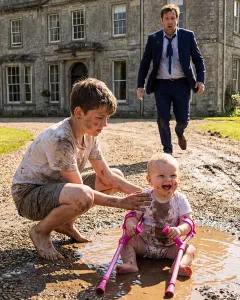
In the middle of a wide puddle of thick, black mud sat Ethan.
And he was laughing.
Not the polite smile he gave therapists. Not the tired grin after exercises. A real laugh—bright and wild.
Beside him stood a boy Jonathan had never seen before, about eight years old, barefoot, wearing faded jeans and a shirt too large for his thin frame. He held Ethan steady with surprising gentleness.
“What are you doing with my son?!” Jonathan shouted, fear quickly turning into anger.
“We’re just playing, sir,” the boy replied calmly, brushing mud from Ethan’s cheek.
“Step away! He can’t be here—he’s sick!”
Jonathan moved to lift Ethan, but the little boy pushed his father’s hand aside. Ethan’s small palms pressed into the mud as he struggled to push himself upward.
“He wants to stand on his own,” the boy said quietly. “Let him try.”
“You don’t understand! The doctors said he doesn’t have the strength!”
“The doctors don’t know what he wants,” the boy answered. “He saw me outside and wanted to come. Strength isn’t only in muscles. It’s here.” He tapped his chest.
Jonathan fell silent. Ethan’s clothes were filthy, his hair plastered to his forehead, but his eyes shone with determination. For the first time in years, he didn’t look like a patient.
He looked like a child.
Fear and instinct battled inside Jonathan. Every medical warning echoed in his mind. But so did something deeper—a father’s voice he had buried under caution.
“Five minutes,” Jonathan whispered hoarsely. “That’s all.”
The boy smiled. “Come on, Ethan. You can do it. Get the ball.”
He held up a ragged, handmade ball stitched from scraps of cloth.
Ethan’s knees trembled as he pushed against the mud. Jonathan stood rigid, ready to catch him.
“Just a little more,” the boy encouraged.
Ethan lifted his torso—then fell.
Jonathan stepped forward, but the boy raised a hand.
“It’s okay. Let him try again.”
“He could get hurt!”
“He’s already hurting,” the boy replied softly. “He just wants to play.”
The words pierced deeper than Jonathan expected.
Ethan tried again. His thin legs shook violently.
And then—miraculously—they straightened.
For one breathless second, Ethan stood.
Jonathan felt tears spill down his face.
Ethan took one shaky step. Then another. He fell back into the puddle, laughing triumphantly.
Jonathan rushed to him, embracing him without caring about the mud or the rain. Ethan hugged the rag ball as if it were treasure.
Jonathan looked at the boy in disbelief.
“How did you do that?”
The boy shrugged. “I just asked him to play.”
It sounded too simple. Yet in five minutes of freedom, Ethan had done what two years of structured therapy had not.
The nanny and security guard arrived, flustered.
“He’ll catch a cold!” the nanny cried.
Jonathan lifted a hand. “It’s fine.”
Even he was surprised by his own calm.
Ethan looked at the boy. “Will you come tomorrow?”
The boy hesitated. “I live down there.” He pointed to a row of small houses at the end of the block.
“What’s your name?” Jonathan asked.
“Lucas Reed.”
“Where are your parents?”
“My mom works all day. My dad left.”
Ethan reached out a muddy hand. “Friend.”
Lucas smiled.
Jonathan felt something inside him shift. For years he had purchased treatments, equipment, expertise. But he had never given Ethan the one thing he truly needed: connection.
“Thank you, Lucas,” Jonathan said sincerely.
Lucas blinked. “For what?”
“For reminding him how to want something.”
That night, Jonathan watched Ethan sleep, still clutching the rag ball. The next day at therapy, Jonathan told Dr. Caldwell what had happened.
“Unexpected progress can occur,” the doctor said cautiously. “But we shouldn’t create unrealistic expectations.”
“He stood,” Jonathan insisted. “He walked.”
The doctor frowned.
At that moment, Ethan slid off the exam table, planted his feet, and—before anyone could react—took two small steps toward a toy on the floor.
Silence filled the room.
“That’s… highly unusual,” Dr. Caldwell murmured.
Jonathan understood then: his son didn’t need more protection. He needed life.
Weeks passed. The Whitman estate changed. Medical equipment remained, but so did toys. Children’s laughter replaced sterile quiet. Lucas visited daily after school. Jonathan met his mother, helped her secure stable employment—respectfully, without charity disguised as pity.
Ethan improved gradually, strengthened by therapy, yes—but also by scraped knees, games, and determination.
One afternoon Jonathan found Lucas repairing the rag ball, its seams nearly undone.
“It’s falling apart,” Jonathan said.
Lucas nodded. “But it’s the ball Ethan used when he stood up.”
Jonathan held it carefully, as if it were priceless.
“Do you know something?” he said.
“What, sir?”
“The miracle wasn’t that he walked.”
“It wasn’t?”
“No. The miracle was that you made him want to try.”
Years later, at Ethan Whitman’s elementary school graduation, Jonathan sat in the audience watching his son walk confidently across the stage. No assistance. No hesitation.
Beside Ethan stood Lucas Reed, taller now, still smiling the same way he had in the rain.
After the ceremony, Ethan ran to his father.
“Dad! I can run now!”
Jonathan hugged him tightly, remembering the puddle, the fear, the choice.
He turned to Lucas. “Thank you… for that day.”
Lucas laughed. “I just invited him to play.”
Yes. Just play.
But sometimes what saves a child isn’t wealth or medicine alone.
Sometimes it’s friendship.
A muddy street.
An old rag ball.
And the courage to let a child live.
That night, as Ethan slept peacefully with his soccer cleats by his bed, Jonathan stood at the doorway feeling a kind of fulfillment no business triumph had ever given him.
His son hadn’t defeated the illness alone.
Joy had defeated fear.
And the miracle had begun with something as simple as a puddle… and a friend.