The call came at 12:47 a.m. on a Friday in late fall.
My phone lit up on the nightstand, cutting through the kind of exhausted sleep that comes only after too many hours at work and not enough with your kid. For a few seconds I just stared at the screen, brain thick with fog, listening to the angry buzz against the wood. Unknown number, local area code.
I almost let it go to voicemail.
Then I saw the little notification banner above it, the one I kept forgetting to turn off: Recent Call: Tucker – 8:11 p.m.
My son.
I snatched the phone up. “Hello?”
There was a sound first, like someone dragging breath across broken glass. Then his voice—thin, high, absolutely terrified.
“Mom?”
Every nerve in my body snapped awake.
“Tuck? Tuck, what’s wrong?”
“He—” His voice broke and came back shrill and raw. “Uncle Colt shoved me! I fell into the recycling and there was glass and I’m bleeding, Mom. There’s blood everywhere. He said—he said if I tell you about the money, nobody will believe me and it’ll be my fault.”
For a heartbeat I couldn’t move, couldn’t think. It was like my mind stalled on a single image: my eleven-year-old boy in my parents’ neat little kitchen, framed in warm light, smiling around a cupcake because I’d had to miss bedtime again.
I had left him.
I had walked out of that house knowing in my bones that I didn’t trust my brother and telling myself it was just one night.
The guilt hit so hard my free hand dug into the mattress.
“Where are you?” I demanded, already fumbling for the lamp, throwing off the covers. “Are you at Nana and Grandpa’s? Is anyone with you?”
“I—I called 911,” he sobbed. “The operator’s still on the line. They said the cops and an ambulance are coming. But Uncle keeps yelling, he keeps saying I attacked him, and I fell on the glass and my arms are all cut up and I’m scared.”
My apartment seemed suddenly too small, the walls closing in. I grabbed the first clothes my fingers found—yesterday’s jeans, a sweater, mismatched socks. My hands shook so badly I could barely get my foot into my shoe.
“I’m coming,” I said. “Do you hear me, Tucker? I’m on my way right now. Stay where the paramedics tell you, okay? Keep talking to the operator. Do not hang up unless they tell you to.”
“He said he’s gonna tell them I tried to stab him,” Tucker whispered, panic fluttering behind every word. “He pushed me into the bins, Mom. I swear I didn’t—”
“I know.” My voice came out so steady it surprised me. The courtroom voice. “I believe you. I always believe you. You did nothing wrong. You called for help. That’s what brave people do.”
There was a muffled shout in the background—my brother’s voice, slurred with rage. “Hang up that phone, Tucker! You hear me?”
My son yelped.
“Don’t you—” I started, but the line crackled, someone else’s voice cutting through.
“Ma’am? This is Officer Kline with Atoria PD. Your son is with us now. We’re transporting him to Atoria General. You can meet us there.”
“How bad is he?” I was halfway to the door with my coat in one hand and my keys in the other, feeling each second scrape against my skin. “How bad?”
“He’s got multiple lacerations on his arms and a facial contusion,” the officer said carefully. “He’s conscious and talking. We’ve got a compression bandage on. You’re his mother, correct?”
“Yes. I’m— I’m Felicity Vance.”
There was a pause.
“The child advocate attorney?” His tone shifted almost imperceptibly.
“Yes.” There was no time to unpack that.
“We’ll get a report from your brother on scene,” he said. “Meet us at the ER entrance. I’ll let them know you’re coming.”
He hung up. I stared at the dark screen for a fraction of a second, my reflection ghosted over it—wild hair, wide eyes, the imprint of a legal pad still faintly visible on my cheek from where I’d fallen asleep over case files.
Then I moved.
Keys. Wallet. Phone. I yanked my coat on as I ran down the stairs, every step echoing the same word in my skull: One night. Just one night.
I was an attorney who fought for kids all day—restraining orders, emergency custody, supervised visitation. I knew the statistics. I knew how often “just one night” turned into a police report and a trauma that never really healed.
And I had still left my son.
The night air slapped my face as I burst out of the building, sharp and cold, the sidewalks slick with earlier rain. My car sat under the streetlight, beaded with water. I jammed the key into the ignition with hands that felt both numb and burning.
The dashboard clock glowed: 12:52 a.m.
Fifteen minutes. Maybe twenty, if I hit every red light. There was no traffic at this hour, but there was always a cop when you didn’t need one and never one when you did.
I pulled out anyway, harder and faster than I should have. The city passed in smeared strips of orange and blue. My brain kept trying to show me things I didn’t want to see: Tucker’s bare arms, smooth and unmarked; his grin as he’d begged me to let him stay at Nana’s; the way Colt had slouched in their doorway, smelling faintly of beer and cigarettes.
“He’ll be fine, Liss,” my mother had said, bristling at my hesitation. “You think we raised you just to forget how to watch a child? Your brother’s here. You can’t keep that boy wrapped in bubble wrap.”
“He doesn’t need bubble wrap,” Colt had chimed in. “He needs family, right, champ?”
Tucker had nodded, not seeing the way his uncle’s jaw clenched when he thought I wasn’t looking. He idolized Colt with the uncomplicated devotion of a kid who saw only the jokes, the magic tricks, the video games. He didn’t see the unpaid debts, the court orders, the trail of ex-girlfriends and employers who all used the same phrases: He just needs help. We hoped he’d change.
We had a restraining order against him in a case file at the county courthouse with my brother’s name on it. Not my order—his ex-fiancée’s. I had read it twice, hand pressed flat hard enough to leave fingerprints in the paper. “Threats of harm. Property damage. Stalking.” I had testified in front of a judge that the order should be made permanent.
And then I had left my son alone in a house with him because an emergency hearing had been dropped on my desk at six p.m. and I had run out of choices and childcare, and my parents had said, over and over, It’s just one night.
I took a corner too fast. The tires screeched.
The hospital’s neon sign rose ahead, an ugly blue glow in the fog. I swung into the emergency lot, braked so hard the seatbelt sliced across my chest, and was out of the car before the engine had really stopped.
Automatic doors whooshed open. The smell of antiseptic and stale coffee hit me like a wall.
“Child brought in by ambulance—boy, about eleven,” I gasped at the triage nurse, fingers wrapped white around the strap of my briefcase. It had come with me like a reflex. “Tucker Vance. I’m his mother.”
The nurse’s eyes flicked over my face, recognition dawning.
“Bay four,” she said, already pointing. “Down the hall, second on the left.”
I ran.
The curtain around Bay Four was half-drawn. I shoved it aside.
For a moment, the scene didn’t make sense. It was like walking into a photograph somebody had cut and rearranged.
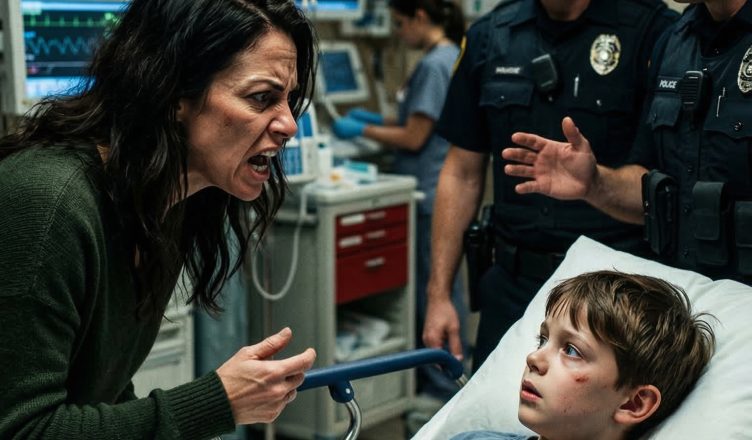
My son lay on a narrow hospital gurney, dwarfed by a standard issue gown. His left wrist was zip-tied to the rail with a thick plastic restraint. The skin underneath it was mottled red and purple. His right cheek was swollen, already blooming into a dark bruise in the shape of a fist.
Blood—my son’s blood—streaked his forearms in jagged lines. Gauze wrapped some of them, already soaked through with deep red. In others, glittering points of glass still caught the light.
Three feet away, my brother leaned against the wall like he was waiting for a bus. One arm folded, the other held out with great significance so everyone could see the thin, white scratch across his index finger. It didn’t even break the skin.
An officer stood at the foot of the bed with a notepad open, pen hovering mid-sentence. Another stood to the side, arms crossed, taking everything in.
My son’s eyes found mine. Relief flashed across his face so bright and raw that it broke my heart.
“Mom.”
His voice was hoarse and small.
Every other detail in the room snapped into terrifying clarity.
“Who authorized restraints on a minor victim?” I asked, my voice arriving before the shock left my body. It came out cool and precise, the way it did when I stood before a judge. “Untie him. Now.”
The older of the two officers—tall, buzzcut, sharp creases in his uniform—stepped forward. His nametag read VARGAS. He had the look of someone who was used to giving orders, not taking them.
But when his gaze landed fully on my face, something changed. And when the other officer—shorter, younger—really looked at me, the color drained from his cheeks.
“You’re—” He swallowed. “You’re the attorney who got that restraining order on the Merriweather case last year.”
I didn’t take my eyes off the zip tie cutting into my son’s skin. “Yes,” I said. “And I’m the mother of that child. Remove the restraint.”
Vargas didn’t argue. He pulled trauma shears from his pocket. The plastic cinch snapped with a harsh little snick.
Tucker’s arm dropped limply to the mattress. His fingers twitched as circulation returned.
I was at his side in two steps, dropping my briefcase without feeling it leave my hand. I cupped his uninjured cheek, careful to avoid the swelling.
“It hurts, Mom,” he whispered.
“I know,” I said. My throat was tight. “We’re going to fix it. I promise.”
Up close, the cuts were worse. Tiny shards of brown and green glass glinted in the torn skin of his forearms, embedded like cruel confetti. One gash along his right arm curved from elbow to wrist—a deep, ugly crescent that made my stomach lurch.
“Who restrained him?” I repeated, this time looking up. “And based on what?”
The younger officer—BROOKS, his tag said—shifted his weight.
“The call came in from the uncle,” he said. He wouldn’t quite meet my eyes. “Report of an aggressive minor who attacked him with a bottle. When we arrived, the boy was upset, wouldn’t stay still for the medic, tried to pull away, so we—”
“You zip-tied a bleeding child to a bed because the alleged assailant said he was ‘aggressive?’” My voice could have frozen the air. “That is not protocol. That is negligence. And it is a liability your department will not enjoy defending in court.”
Nurse Patel appeared on the other side of the bed with a tray of supplies: saline, sutures, a tetanus shot, bandages. She hesitated when she saw the restrain mark, the angry ring already forming under the break in the tie.
“Policy says we only remove restraints on officer order,” she murmured.
“Order given,” Vargas said crisply.
I nodded once in his direction, acknowledging the bare minimum.
Colt pushed off the wall, irritation flaring in his eyes as he realized the narrative was slipping out of his hands.
“This is ridiculous,” he snapped. “He came at me with that bottle. Look at my hand.” He thrust the scratched finger toward the nearest cop like Exhibit A. “He’s always been dramatic. You know that, Liss.”
I didn’t bother looking at him. “Yes,” I said. “He’s dramatic. He’s also eleven. And currently has between—” I scanned the jagged lines on Tucker’s arms, counting automatically “—twenty and thirty separate lacerations requiring sutures. We don’t zip-tie that.”
Nurse Patel began flushing the deepest wounds with saline. Tucker hissed and tried to pull away.
“Scale of one to ten?” she asked gently.
“Eight,” he whispered, voice trembling.
“Get him something for pain,” I said. “Morphine, low dose. And I want imaging. X-rays of both arms and his face. There may be retained fragments.”
The nurse nodded, already reaching for a syringe.
Brooks cleared his throat.
“Ma’am,” he said, sounding younger than he looked. “Ms. Vance. I responded to the call at your parents’ house. Your brother—” he glanced at Colt, then back at me “—reported that the boy grabbed a bottle and attacked him. He said he pushed the boy away in self-defense, that the fall into the glass was accidental.”
“And you believed him.” I let that settle for a moment. “So much that you restrained the child and left the adult unrestrained in the same room?”
“That’s standard procedure,” Colt cut in quickly, sensing the shift. “He’s out of control. Always has been. Spoiled. You should hear how he talks to—”
“Be quiet,” I said, not raising my voice.
The word sliced through the air with surprising force. Colt’s mouth snapped shut.
Vargas crossed his arms.
“Body cams were rolling,” he said. “We’ll review the footage. Starting with entry into the residence. If the report is inaccurate, it will be corrected.”
There was a warning in his tone—not for me.
Nurse Patel injected the morphine. Tucker’s eyelids fluttered.
“Look at me, baby,” I said, brushing a curl from his forehead. “Stay with me for a second. I need you to tell me what happened. You don’t have to be brave. Just tell the truth.”…. 