No one moved.
The fountain water kept falling, tourists stayed frozen with their phones half-raised, and the little girl remained on her knees by the stone edge, crying softly as if she had expected pain but not recognition.
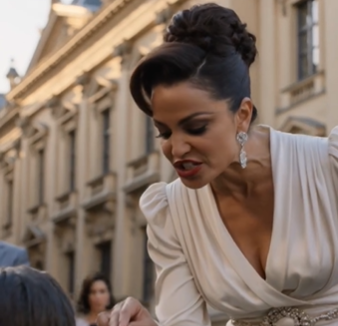
The glamorous woman tried to laugh it off first.
“It’s just a stitched mark,” she said too quickly. “That proves nothing.”
But her voice sounded weak now.
Because the elderly violinist was no longer looking at her.
He was staring at the girl.
Years ago, his daughter had stood in that same square, young and terrified, whispering that she had to hide her baby before powerful people took everything from her. Then one evening she disappeared. By the next day, everyone said she had run away. No one believed a poor musician could demand truth from rich families.
But now the child was here.
Alive.
The little girl lowered her eyes and whispered:
“My mother said if the old man started shaking when he saw the symbol… then I found the right square.”
A gasp moved through the tourists.
The violinist stepped closer and looked at the stitched mark on her sleeve.
It was a tiny crescent and star, hand-sewn in blue thread.
He remembered it instantly. He had sewn it with his daughter by candlelight onto a baby blanket the night she begged him to help her hide the child until it was safe.
His whole face collapsed.
The child reached into her torn coat and pulled out one more thing—
a folded piece of paper, stained by water and age.
The violinist opened it with trembling fingers.
Inside, in faded handwriting, were the words:
“If she reaches the fountain, tell her grandfather I tried to bring her back before they erased my name from this city.”
The square went colder.
Now every eye turned toward the glamorous woman.
Because some people recognized her too.
She had once lived in the district nearby.
She had known the father.
She had been there the year the musician’s daughter vanished.
And she had reacted far too quickly when the girl appeared.
The child’s voice shook through tears:
“My mother said the first person who hurt me would already know why I was left behind.”
The violinist looked at the girl again.
The same eyes.
The same mouth.
The same quiet pain his daughter wore when she was trying not to cry in public.
The glamorous woman stepped backward.
The tourists who had been filming were no longer smiling.
And just before she turned to disappear into the crowd, the old violinist asked the question that shattered the entire square forever:
“You didn’t strike her because she was poor… did you recognize my granddaughter the moment you saw that symbol?”