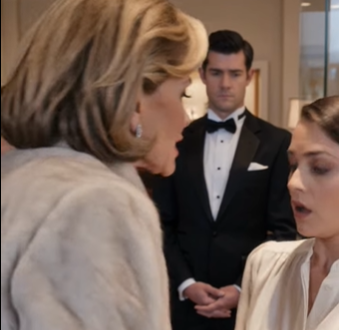
The diamond lights still glittered across the glass cases. Reflections still ran over polished floors and mirrored panels. But the room had changed completely. A moment earlier, it had looked like a simple humiliation — a rich fiancée shaming a poorer sales assistant in public for touching something “above her station.” Now that same ring had become evidence. Not of theft. Not of envy. Of history.
The rich woman stood in the center of the showroom with her face drained of color, still trying to understand how a ring she thought marked the beginning of her future had suddenly opened a door into someone else’s past. The poor sales assistant, meanwhile, was trembling so badly her hands had to grip the edge of the counter to keep from shaking apart. She was still humiliated, still close to tears, but now the room could no longer mistake her silence for guilt. It was grief.
The older jeweler looked at the inner engraving again and explained what he already feared. The date inside the ring was not a manufacturing stamp or a repair code. It was the original sale date, hand-inscribed in the boutique archive system only for private bridal pieces. And beneath the date — almost invisible unless you knew where to look — was the first bride’s order mark. That mark did not belong to the current fiancée. It belonged to a woman whose custom bridal file had once been opened, completed, and then quietly closed years earlier.
The rich woman turned slowly toward the jeweler.
“What do you mean, another bride?”
His answer came too quietly for comfort.
“I mean this ring was bought before you.”
That sentence moved through the customers like ice.
Now the fiancé was no longer simply nervous in the background. He looked cornered. Exposed. Like a man who had hoped money, polish, and timing would keep the same object from ever speaking twice.
The sales assistant finally found enough breath to speak. She said he bought the ring two years earlier, when he still told her their future just had to remain private “for a while.” He said his family was difficult. He said inheritance was complicated. He said some women are introduced to the world only after the world is prepared to deserve them. It sounded romantic then. Later, it sounded like delay. Then like cowardice. And finally like burial.
The rich woman stared at the fiancé.
“You bought this for her?”
He still said nothing.
That silence hit harder than confession.
Because now every elegant thing in the showroom looked contaminated by it. The proposal. The velvet box. The boutique appointment. The excited future he had been shopping for. All of it had been built around an object he had already used once to promise forever.
The jeweler added the detail that broke the illusion completely. The ring had not merely once belonged to another intended bride. It had been brought back months earlier under the fiancé’s private instruction for polishing and resizing. Not resale. Not redesign. Re-presentation. In other words, he had not stumbled into the past. He had deliberately cleaned it, adjusted it, and prepared to place it on another woman’s hand.
The rich woman’s face changed again.
Not only heartbreak now.
Humiliation.
Because she had not almost received a new promise. She had nearly become the public replacement for a private one.
The sales assistant’s eyes filled fully then. She said she never planned to confront him in front of strangers. She only asked him, quietly, the moment she saw the appointment name, to tell the truth himself before the ring left the case again. He refused. So when the rich woman ripped it from her hands and mocked her for touching something she “could never afford,” the cruelty itself became the moment the lie no longer deserved protection.
That was what made the room go still all over again.
Not simply that he lied.
But that she was humiliated with the evidence of her own erased future still in her hand.
The rich woman looked down at the ring again, as if she could now feel another woman’s time pressed into the gold. Then she asked the one question that mattered most.
“Were you ever actually going to tell me?”
The fiancé opened his mouth.
Too late.
The answer no longer mattered as much as the timing. He had already chosen delay over honesty, polish over truth, and a second proposal over the dignity of ending the first one properly.
The sales assistant stood there still shaking, still tearful, still in uniform beneath lights designed to flatter diamonds and expose flaws. But she was no longer the smallest person in the room. The ring had changed that. It had returned history to her at the exact second another woman tried to shame her out of it.
When she finally spoke again, her voice was quiet enough to make the whole boutique listen harder.
“I wasn’t touching something I could never afford,” she said.
Her eyes stayed on the ring.
“I was touching the promise he couldn’t bear to admit he already broke.”