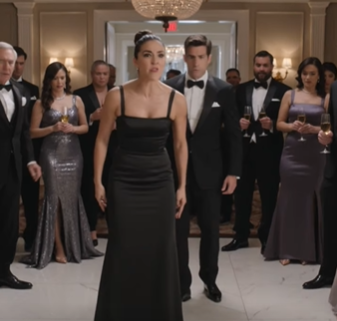
The chandeliers still glittered above crystal and gold. The catering staff stood frozen beside silver trays. The string quartet had gone silent, bows lowered, while guests in gowns and tuxedos held their phones half-raised, no longer filming an elegant engagement toast derailed by drama, but the public collapse of a life that had clearly been built on omission. Only moments earlier, the soaked woman at the door had looked like the kind of person wealthy rooms are trained to dismiss quickly — emotional, disheveled, inconvenient, out of place. But once the ring was opened, once the engraving date was read aloud, she no longer looked like a random intruder. She looked like unfinished history.
The fiancée kept staring at the ring in her hand as if it might somehow become different if she held it still long enough. But metal does not panic, and engraved dates do not lie to protect men in tailored suits. The groom, on the other hand, looked as though every polished instinct in him had failed at once. He did not move toward the soaked woman. He did not move toward his fiancée. He simply stood there in the center of his own celebration wearing the expression of a man who had delayed truth for so long that he no longer knew which lie to save first.
The older family member — his uncle, as some of the guests now realized — stepped closer and explained that he recognized the ring because he had seen the design sketch years earlier. It had been commissioned privately, before the groom’s current relationship was ever announced, during a period the family later described as “a complicated misunderstanding.” At the time, they were told the earlier engagement dissolved quietly, that the woman involved had become unstable, that the matter was resolved and not to be discussed again. The family did what wealthy families often do with inconvenient truths: they accepted the version that made the photographs cleaner.
The soaked woman gave a short, broken laugh through her tears.
“Unstable,” she said. “That’s what he told everyone?”
The fiancée finally lifted her head.
Now she was no longer looking at the woman with contempt. She was looking at her like a witness.
The woman said she met him three years earlier, long before tonight’s guests were choosing centerpieces and tuxedos. He pursued her intensely, privately, insistently — the kind of pursuit that makes women mistake secrecy for depth. He introduced her to parts of his world, but never all of it. There was always a reason not to be seen together in public, always one more family issue, one more business situation, one more explanation for why “timing” mattered. Then came the promise. The ring. The proposal. The vows spoken in private so they would “mean more when they became public.” She believed him because that is what lies are built for.
The fiancée’s fingers tightened around the ring.
The woman continued. Months later, he began changing. Calls grew shorter. Visits became rarer. Every question became an argument. Every request for clarity became “pressure.” When she asked when he would announce their engagement, he told her to wait until he resolved things with his family. Then came the silence. Then came the rumors. Then came the photographs — photographs of him at charity events, yacht parties, and finally dinner tables with the woman now standing in front of him wearing the ring he planned to give a second time in a different form.
A ripple of disgust moved through the guests.
Because now this was no longer an overlap of relationships.
It was duplication.
The fiancée stepped toward him.
“Tell me she’s lying.”
But the groom still said nothing.
That silence did what confession could not. It took every expensive detail of the room — the flowers, the crystal, the gown, the speeches waiting to happen — and turned them into decoration around cowardice.
The woman said she would have stayed silent if betrayal had been the only wound. She would have let herself be humiliated privately. But two weeks earlier, one of his assistants contacted her by mistake while forwarding updated guest logistics for “the engagement announcement.” That was when she learned not only that he was marrying someone else, but that the truth was going to be erased so completely that her existence would be rewritten as an episode of instability rather than what it really was: a prior promise abandoned because he believed he could outspend memory.
The uncle shut his eyes briefly.
Then he said the thing nobody wanted to hear but everyone now understood.
“This wasn’t a misunderstanding,” he said. “This was replacement.”
That landed over the room with lethal force.
Because that was exactly what it looked like now. One woman promised. Hidden. Delayed. Discarded. Another installed into the public version of the future. Same mansion. Same family. Same groom. Cleaner story.
The fiancée looked down at the ring again, then back at the soaked woman.
“Why tonight?” she asked.
The woman’s answer came immediately.
“Because he promised me himself.”
She said he called her three nights ago after she threatened to send the ring to the family. He begged her not to destroy his life publicly. He said he would tell the truth tonight — before the toast, before the announcement, before another woman put on a dress and became part of the lie. She did not come to crash the party blindly. She came because he promised her this would be the night he stopped hiding behind money and timing.
Every eye in the room went back to him.
He looked smaller now. Not physically, but morally. Like a man suddenly standing without the armor of control.
The fiancée’s voice changed then. It lost the social polish and became something sharper.
“So you invited me here,” she said, “knowing there was another engagement behind mine?”
He tried, finally, to speak.
“It wasn’t like that—”
The soaked woman cut in, crying again now but steadier than before.
“Then tell her why the engraving says Forever, before the world knows.”
The fiancée’s face emptied.
She turned the ring and read the inner inscription fully.
The room did not need her to repeat it. Her expression did enough.
The uncle looked at the groom with visible shame.
“You gave private vows first,” he said. “Then built a public one on top of them.”
That was the moment the glamour of the evening truly died.
Not with the shattered glass.
Not with the scream.
Not even with the first ring.
With the realization that the entire engagement party had been arranged inside a lie old enough to have its own engraving.
The fiancée was no longer crying. That was what made her frightening now. Humiliation had moved through her and come out colder on the other side. She looked at the soaked woman, really looked at her, and for the first time saw not a dramatic interruption, but the person who had arrived carrying the remains of the future she herself was standing inside.
The woman lowered her voice and said one last thing. She had not brought only the ring. Inside the velvet box, under the slot where it had rested, was the original appointment card from the jeweler. Same date. Same surname. Same signature. He had not merely spoken recklessly years ago. He had formalized it. Measured it. Paid for it. Planned it.
The fiancée did not even look at the card when it was offered.
She no longer needed more proof.
The groom did.
Because now everyone in the room understood what he had tried to do. He was not just cheating. He was curating reality — deciding which woman lived in memory, which one lived in secrecy, and which version of himself got champagne and applause.
When the fiancée finally spoke again, her voice was soft enough to make the entire mansion listen harder.
“You didn’t almost marry me under a lie,” she said.
She looked at the ring in her hand.
Then at the soaked woman.
Then at him.
“You built my whole yes on top of someone else’s first.”