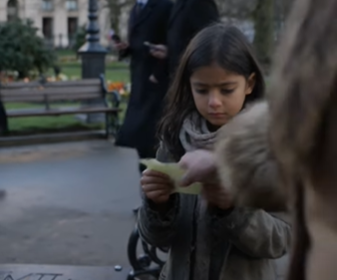
No one in the park moved.
The wind pushed dead leaves across the path, but around that bench, everything felt frozen.
The elderly violinist knelt slowly in front of the girl, his old hands trembling so badly he could hardly hold himself steady.
The rich woman took a step back, suddenly unsure of herself.
“This is impossible,” she said quietly.
But nobody looked at her.
The child clutched the wet note to her chest and cried as if she had been carrying this moment for her whole life without understanding it.
The violinist’s voice shook.
“Who told you to come here?”
The little girl swallowed hard.
“My mother,” she whispered. “She said if I ever had no one left… I had to stand by this bench and wait for the man who carved the names before she was taken away.”
A gasp rippled through the people gathered around them.
The violinist covered his mouth with one hand.
“Taken away?” he repeated.
The girl nodded, crying harder now.
“She said she couldn’t run when they came. She said if she didn’t survive, this bench would remember for her.”
The rich woman’s face lost all color.
The violinist carefully reached for the note.
The little girl let him take it.
The paper was soaked and wrinkled, but the writing inside could still be read.
He opened it with shaking fingers.
The first line shattered him.
Father, if this note reaches you, then the little girl beside this bench is mine.
A woman nearby burst into tears.
The violinist could barely breathe now.
He kept reading.
I carved our initials here the day I told you I was pregnant, because I was afraid no one else would believe me later. If they erase me, don’t let them erase her too.
His knees nearly gave out.
The child stared at him through tears, not understanding why a stranger was looking at her like he had found a piece of his soul after years of burial.
Then he saw something else.
Sewn badly into the inside hem of her torn sleeve was a second set of initials.
The same initials his daughter had stitched into her own scarves since she was sixteen.
His hands shook even harder.
The rich woman backed away another step.
And then the violinist looked at the girl’s face again — really looked.
The eyes.
The mouth.
The way she cried without making a sound at first.
His daughter.
His daughter in that child.
He broke.
In the middle of the cold city park, beside wet leaves and iron benches and strangers holding phones, the old man fell to his knees and wept.
Because the little girl people had ignored, mocked, and treated like a nuisance had not been standing there by accident.
She had come home to the last place her mother believed love would still remember her.