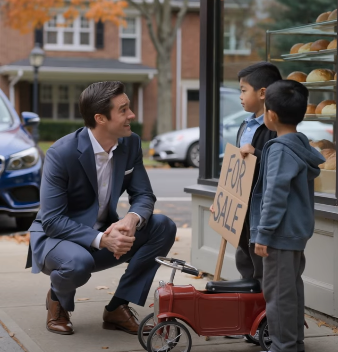
The bakery window glowed behind them.
Cars passed.
Leaves moved.
But for the man, the whole street had gone silent.
His eyes were fixed on the note in his hands.
The handwriting was shaky, uneven, like it had been written by someone weak, or crying, or both.
It said:
If you are reading this, it means my boys found the right man.
Please tell them I never stopped loving their father.
The man looked up too fast.
At the boys.
At their eyes.
At the shape of the older one’s mouth when he tried not to cry.
His breath caught.
Because years ago, before the suit, before the dark car, before the life that made him look untouchable, there had been a woman.
Warm. Quiet. Poor.
And he had loved her.
Truly.
But when she became pregnant, his family stepped in.
They told him she had left town.
Told her he had chosen someone else.
Told both of them the same lie in different words.
And it worked.
Until now.
The older boy looked at him carefully.
“Mama said if you were good…”
His voice shook.
“…you’d stop for us.”
The man knelt lower, staring at them as the truth rearranged his whole life right there on the sidewalk.
“What’s your mother’s name?” he asked softly.
The older boy answered.
And that was enough.
Enough to break him.
The younger brother moved closer to the older one and whispered:
“Is he the one?”
The man heard it.
Every word.
Every year he had lost.
He looked toward the bakery window, using the reflection to hide the tears suddenly filling his eyes.
Then he saw one more thing in the note.
A final line.
She’s inside. She was too ashamed to come out.
The man turned slowly toward the warm bakery glass.
And there—
sitting alone in the corner, pale and trembling behind the window—
was the woman he had been told abandoned him.
Watching the boys through tears.
Watching him.
Too afraid to believe kindness had really stopped.
That was when the little red pedal car stopped being just a toy.
It became the thing two children were willing to lose
to save the mother
who had spent years losing everything else.