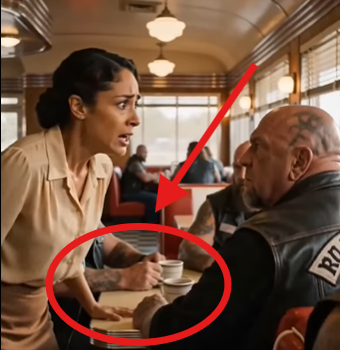
No one in the diner moved.
Not the waitress by the pie case. Not the old man at the counter. Not even the other bikers in the booth.
The lead biker looked down at the woman’s hand gripping his wrist, then at the birthmark he had seen a thousand times and never thought about twice.
The woman was crying now.
Not soft tears.
The kind that come from somewhere old enough to hurt your bones.
“I knew it,” she whispered. “I knew they lied to me.”
The suited man’s voice turned sharp. “Don’t do this here.”
The biker’s eyes narrowed. “Do what?”
The woman looked up at him like she was seeing two lives at once—his face now, and another face she had once kissed before it was taken from her.
“When you were a baby,” she said, trembling, “they told me you died in the hospital. They wouldn’t let me hold you. They wouldn’t even let me see you.”
The biker didn’t speak.
The three men behind him slowly stood up from the booth.
The suited man glanced at the diner door, realizing too late that the room no longer belonged to him.
“That’s not what happened,” he said.
The woman turned on him with sudden fury. “Then why did your family pay me to disappear?”
That hit harder than any shout.
A glass clinked somewhere in the silence.
The biker looked between them. “Start talking.”
The suited man straightened his jacket, trying to rebuild the confidence that had walked in with him.
“My father couldn’t allow a scandal,” he said. “She was a housekeeper. My brother was engaged. A child would have ruined everything.”
The woman shut her eyes like the truth still had teeth.
The biker’s face changed—not louder, not wilder. Just colder.
“You stole me.”
“No,” the suited man said quickly. “I saved you. You were raised with money, education, a future—”
“I was raised in foster homes,” the biker said.
That landed like a hammer.
Even the other bikers turned to him.
He swallowed once, eyes never leaving the man in the suit. “Family never kept me. Nobody ever stayed.”
The suited man’s expression cracked.
Because that part, apparently, even he hadn’t known.
The woman stepped forward. “I searched for him for years.”
Her voice broke.
“I kept his hospital bracelet. I kept the blanket they wrapped him in. I came to this town every year on his birthday and sat outside that church because it was the last place I saw the car that took him away.”
The biker stared at her.
A memory stirred—nothing clear, just a shape he had never understood. A woman in brown. The smell of vanilla. A song hummed softly in the dark.
The woman reached into her purse with shaking hands and pulled out a tiny silver medallion on a worn chain.
On the back were engraved words:
For Michael. Come back to me.
The biker touched his own chest under the leather vest.
Slowly, he pulled out the other half of the same medallion.
The diner went dead silent.
The woman made a broken sound and covered her mouth.
The suited man took a step back.
Bad move.
The other three bikers closed in at once—not attacking, just surrounding, like doors locking.
The lead biker looked at the man in the suit with terrifying calm.
“You spent twenty-seven years keeping a mother from her son,” he said.
Then he took the woman’s shaking hand and placed it on his face.
Her fingers trembled against his cheek.
This time, he didn’t pull away.
The suited man glanced toward the exit again, but one of the bikers dragged a chair into the aisle without even looking at him.
Blocked.
Done.
The lead biker’s voice dropped lower.
“Now you’re gonna sit down,” he said, “and tell her everything.”
And behind him, the woman whispered through tears she could barely survive:
“My boy.”