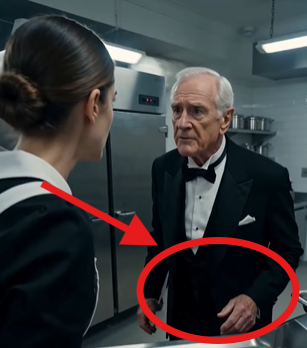
For one long second, no one in the palace moved.
Not the guests in the doorway.
Not the servants behind the counters.
Not even the maid.
Because one word had already changed the shape of the room:
heir.
The maid stared at the older man as if language itself had stopped making sense. She was still wearing a black-and-white uniform. Her apron was half untied. Her hands were damp from dishwater. Nothing about her looked royal except the way every other person in the room had suddenly begun to fear her.
The woman in gold was the first to find her voice.
“She’s lying by existing,” she said, but the sentence collapsed under its own panic.
The older man didn’t even look at her.
Years earlier, the youngest daughter of the royal house had disappeared during a fire in the east wing nursery. The palace mourned, the papers printed black borders, and the line of inheritance shifted cleanly upward — exactly where the woman in gold and her husband needed it to go.
But the older man standing in the kitchen had been there that night.
He had been chamberlain then.
He saw the smoke, heard the baby cry, and watched one terrified palace maid carry the child out through the servant corridors while the nobles upstairs were already deciding which version of grief would preserve the succession best.
That child was hidden.
Raised under another name.
Passed from household to household.
Eventually brought back into the palace itself through service, irony so brutal no one would have dared write it.
And now she had been found not by prophecy or miracle —
but by a birthmark behind her ear, the exact one painted in miniature on the lost princess’s infant portrait.
The older man finally finished the sentence he had begun.
“Princess Elena.”
The maid’s knees nearly gave.
Because suddenly every strange thing in her life rearranged itself: the old housekeeper who cried the first day she saw her, the rules about never entering the east corridor, the way the Queen used to stare at her for too long and then ask for tea she never drank.
The woman in gold stepped back again.
Not because of shame.
Because the truth had mass now.
If Elena lived, then the line had never broken.
If the line had never broken, then titles, estates, promises, and marriages built on that absence had all been standing on air.
The maid looked at the crowd in the doorway and for the first time understood the horror in their faces: they had not been staring at a servant.
They had been ordering around the rightful heir.
The older man reached into his jacket and unfolded a velvet packet. Inside lay a tiny gold bracelet engraved with an infant name and date — the missing piece from the palace archives, hidden for decades because it was proof the child survived the fire.
He held it out.
The maid looked at it, then at him, then at the woman in gold, whose lips were trembling now with a fear too deep for denial.
“Why?” the maid whispered.
That was the cruelest question in the room.
Because there are many reasons people steal wealth, power, or land.
But stealing a child’s name takes a colder kind of ambition.
The woman in gold finally broke.
“Because you were born first.”
Silence.
No one in the doorway even tried to breathe.
That was the whole crime, laid bare in one sentence: not hatred, not madness, not even personal spite. Sequence. Birth order. A single place in a line of inheritance, and an entire life stripped away to move someone else one step closer to a crown.
The maid pressed her wet hand against her own mouth.
And suddenly the palace kitchen, with its running water and stainless steel sink, became the place where a servant’s life ended and an heir’s began.
Not because she changed.
Because the lie around her finally did.