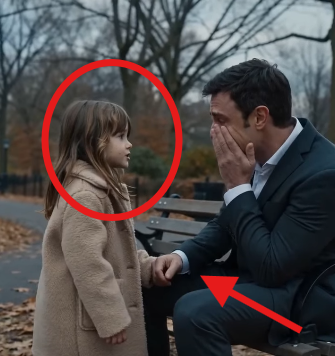
For one long second, nobody moved.
Not the man.
Not the woman on the path.
Not even the little girl between them.
Because everything that had once been buried was now standing in open air.
The woman stopped short when she reached them.
Her face had gone white.
Not from running.
From seeing who was on the bench.
The man stood slowly.
All the grief that had been bent over in silence just seconds earlier was gone now, replaced by something far more dangerous:
hope.
And fear of it.
He looked at the woman and said her name like it had stayed alive in him longer than anger ever could.
She looked at the little girl first.
Then at him.
That was answer enough.
The child stared between them, confused but alert, sensing that whatever this was had started long before she was born.
The man’s voice came rough.
“Sofia is yours?”
The woman nodded once.
Barely.
He looked at the girl again.
At the mole.
At the eyes.
At the impossible calm.
Then back at her mother.
“Why didn’t you tell me?”
That question hurt because she had clearly been hearing it from herself for years.
The woman swallowed hard and finally said the truth.
Because years earlier, after they had been together, she disappeared without warning. He had believed what everyone around him told him: she left, she chose another life, she didn’t want to be found. But that was never the whole story.
His father found out first.
A powerful man.
A careful man.
The kind who solved family embarrassment with money and threats.
She had been told to leave quietly and never come back. She was promised safety if she disappeared before the pregnancy showed. When she refused, the threats changed. Not to her.
To him.
To his future.
His career.
His life.
So she vanished and carried the child alone.
The man stood there listening while the park around them kept pretending to be ordinary.
A jogger passed in the distance.
Leaves scraped along the path.
But nothing in the world felt normal anymore.
Sofia looked up at her mother, then at him.
“Are you why she cries at night?”
That question shattered the last of the adults’ control.
Because children never ask for drama.
Only patterns.
The woman closed her eyes.
The man looked away for one second, like guilt had become physical.
Then he knelt in front of the little girl.
Not because he had answers.
Because he wanted to be closer to the truth.
He asked carefully:
“Did your mom tell you about me?”
Sofia nodded.
“She said there was a man who laughed like thunder and got scared when he loved too much.”
The man broke at that.
Quietly. Completely.
Because that was exactly the kind of sentence her mother used to make when she wanted to wound him and adore him at the same time.
He looked up at the woman again and now saw what he had missed at first:
the exhaustion, the caution, the years of carrying too much without asking anyone to help.
And suddenly the bench in the park wasn’t just where a crying man was interrupted by a child.
It was where a lost life walked back in wearing a little brown coat and asking simple questions no adult had been brave enough to ask out loud.