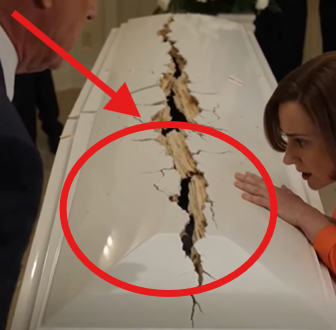
For one long second, nobody in the funeral parlor moved.
Not the mourners.
Not the maid.
Not even the older man.
Because the ring changed everything.
It was not just a hand inside the coffin.
It was his ring on that hand.
A heavy family signet, impossible to miss, engraved with the crest everyone in the room knew belonged only to him.
The maid stared from the hand… to the man… then back again.
And suddenly the horror shifted shape.
This wasn’t a miracle.
This was a secret exploding at the worst possible moment.
The hand pushed harder through the splintered lid. Then another weak knock came from inside, followed by a choked breath. The older man stumbled forward, no longer commanding, no longer furious, just shattered.
Two mourners rushed in and together they pulled the cracked lid aside.
Inside lay Emily.
Pale. Dazed. Alive.
Her lips were dry, her breathing ragged, her wrists bruised where ribbon and funeral fabric had pressed too tightly. Her eyes fluttered open in confusion, then in terror, then fixed straight on the older man.
The whole room went dead.
Because now everyone understood the worst part:
she had not been mistakenly buried.
She had been prepared for burial while still alive.
The maid began crying from pure relief and rage.
“I told you,” she whispered. “I heard her scratching when I brought the flowers.”
Emily tried to sit up, but her body failed her. One of the women in mourning caught her shoulders and held her carefully.
The older man dropped to his knees beside the coffin.
Not from grief.
From collapse.
Because the ring on her wrist had already told the room what his mouth hadn’t:
he had put it there.
Or someone acting for him had.
A final token. A last claim. A lie disguised as sentiment.
Emily’s hand shook as she ripped the ring free and threw it at his chest.
It hit his suit and dropped to the polished floor.
That sound was somehow louder than the axe.
One mourner whispered, horrified, “What did you do?”
The older man opened his mouth, but Emily spoke first.
“He said it would be easier if they thought I was gone.”
No one breathed.
She forced another breath.
“He said I knew too much.”
That was the true burial.
Not a woman in a coffin.
A witness.
Emily had found documents. Transfers. Signatures. Proof that the older man had been siphoning estate money for years, hiding losses behind false trusts and dead accounts. She threatened to expose him before the reading of the will.
So he solved the problem in the oldest, cruelest way possible:
not by killing her outright—
but by making her disappear in a way everyone would mourn too quickly to question.
The maid looked at him with something colder than hatred now.
“You gave her your ring because you thought dead women can’t speak.”
Emily’s voice broke, but she kept going.
“You told them I was sick. You told them not to open the coffin.”
That was what finally broke the room.
Because they all remembered.
The rushed preparations.
The closed lid.
The insistence.
The grief directed away from suspicion.
The older man tried to speak again, but nothing he could say would survive what was already alive in the room.
The pale woman in the coffin.
The ring on the floor.
The maid with the axe who had been the only person brave enough to believe a sound no one else wanted to hear.
And suddenly the entire funeral had changed from mourning a death
to witnessing a failed burial.