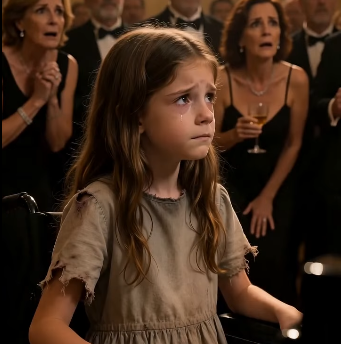
No one in the ballroom moved.
Julian stood frozen beside the piano, staring at the little silver key as if it had unlocked the wrong year and dragged it bleeding into the present.
The girl lowered her hand slowly, but did not put the key away.
Her eyes stayed on him.
Not accusing.
That was worse.
If she had hated him, he would have known where to stand.
But this look—hurt, steady, waiting—made him feel like a man already being judged by the only witness who mattered.
“What is your name?” he asked.
The room was so quiet that even the smallest breath from the audience sounded like part of the answer.
“Lina.”
The name hit him physically.
Because Eva had chosen it one evening while sitting barefoot on the floor, laughing over baby names and cheap tea.
If it’s a girl, Lina, she had said. Because it sounds like something soft surviving a storm.
Julian’s eyes filled at once.
The audience behind him had stopped being a crowd. They were witnesses now. They could feel the shape of the truth even before they understood it.
Julian took another step closer to the piano.
“Your mother,” he said, and his voice almost failed him. “Where is she?”
Lina looked down at the key.
Then back up.
“She couldn’t come.”
That answer made something in him collapse.
“Why?”
Lina’s lower lip trembled for the first time.
“Because she’s been dead for three months.”
A woman in the audience gasped.
Someone dropped a glass in the back of the room, and the sound shattered through the silence, but no one turned to look.
Julian didn’t blink.
Didn’t breathe.
Didn’t know how to stand inside that sentence.
Lina kept speaking because children forced to carry truth for too long learn to finish painful things before adults can interrupt them.
“She left me with Sister Agnes at Saint Martha’s Home,” she said. “She said if you ever held a charity gala with a piano again, I should come play this song and show you the key before the men around you could stop me.”
Julian’s face changed.
The men around him.
Not men in general.
Specific men.
His family’s men.
His father’s lawyers. His household staff. The old machinery of power that had once separated him from Eva and then buried the guilt beneath polished years.
Lina reached into her dress pocket again.
This time she pulled out a folded letter, worn soft at the edges.
She held it out.
Julian took it with shaking hands.
It was addressed in Eva’s handwriting.
For Julian — if our daughter reaches you before your courage does.
That one line nearly ruined him before he even opened it.
He unfolded the paper.
Read.
And with every line, the ballroom seemed to move farther away.
Eva wrote that she had waited for him until waiting became hunger. That his father’s men had found her before he did. That they offered money to disappear and threats if she didn’t. That she kept the key because it was the only proof she had that once, before the fear, Julian had meant to choose them.
At the bottom of the letter, one final line was written harder than the rest:
The bench still holds what you were too afraid to become. If you open it, do it in front of her.
Julian lowered the letter slowly.
His whole face was wet now.
He looked at Lina, at the wheelchair, at the small worn dress, at the little hands that had just played his own secret back into him.
“Your legs…” he whispered, because it was the only part of reality he could still touch.
Lina answered quietly.
“Car accident. Two winters ago. Mom said I should never pity you for leaving, because life breaks people in different places.”
That finished him.
He knelt beside the piano.
Not elegantly.
Not as the rich man in the tuxedo.
As a father arriving obscenely late.
“I should have come back,” he said.
Lina stared at him.
“Yes,” she said.
No drama in it.
Just truth.
And somehow that was far crueler and far more merciful than anything else she could have said.
Julian nodded once, accepting the wound.
Then he took the key from her hand, crossed to the piano bench, and inserted it into a hidden slot underneath the velvet cushion.
The lock turned.
A soft click.
He opened the compartment.
Inside lay three things:
a silver ring wrapped in faded blue ribbon,
a photograph of him and Eva standing beside the same piano years earlier,
and a sealed document folder.
Julian opened the folder first.
It was a trust.
Legally drafted. Never filed.
Created in Lina’s name twenty-one years ago.
His name signed at the bottom.
His father’s lawyer’s notation across the corner:
Held pending compliance.
His father had found it. Intercepted it. Buried it.
Julian shut his eyes.
When he opened them again, there was no confusion left in him. Only grief. And certainty.
He turned back to Lina and lifted the ring.
“I bought this for your mother,” he said. “The same week I wrote that song.”
Lina’s face cracked at last.
Not because of the ring.
Because she could hear the truth in his voice now.
Too late truth. But truth.
Julian came back to her, crouched in front of the wheelchair, and held out the photograph instead of the ring.
“That night,” he said, “I was a man who thought love would survive cowardice.” His mouth shook. “He was wrong.”
A tear slipped down Lina’s face.
Julian gently wiped it away with the back of one finger, asking permission in the movement. She let him.
Then he said the one thing the whole ballroom had been waiting for without knowing it:
“If you let me, I will spend the rest of my life being less late.”
Lina looked at him for a long time.
At the man who had written the song.
At the father who had missed everything.
At the stranger who was now kneeling in front of her with her mother’s letter in his shaking hands.
Then she whispered:
“Mom said you would cry before I believed you.”
A small, broken laugh escaped him through tears.
“That sounds like her.”
Lina nodded.
And for the first time since she entered the hall, she reached toward him first.
Julian took her hand like something sacred.
Behind them, the audience remained frozen—not from confusion now, but from the quiet horror of realizing they had come for a performance and witnessed a hidden life being returned to its name.
And in the warm gold light of the ballroom, beside the piano that had held a family secret for two decades, a girl in a wheelchair stopped being a test of charity—
and became the daughter who had come back carrying the key her father left behind.