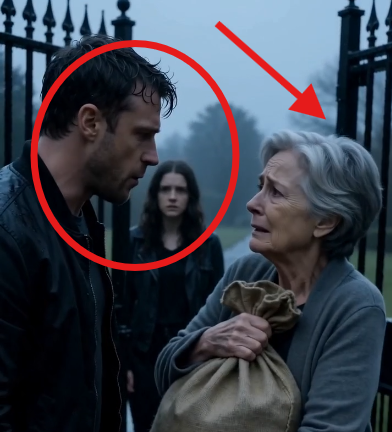
The old woman didn’t think.
She moved.
The chair scraped.
The door slammed open.
Cold rain hit her face like punishment as she ran barefoot onto the stone path, the note still crushed in her fist.
“NO!”
Her scream ripped through the rain.
Both of them turned.
Her son’s face changed first—
shock,
then terror.
The young woman’s hand tightened around the gun.
“Go back inside,” she snapped.
But the old woman kept coming.
She didn’t care about the rain.
Didn’t care about the mud.
Didn’t care that her heart was pounding so hard it felt like it might split.
All she could see was her son standing there with his whole life about to disappear.
He stepped in front of her instinctively, even now, even when he was the one in danger.
“Mom, stop,” he said, voice breaking. “Please.”
That word destroyed her.
Please.
Not because he wanted her gone.
Because he wanted her alive.
The young woman laughed once, bitter and shaking.
“You should’ve let her walk away.”
The old woman looked at the gun.
Then at the tears on her son’s face.
Then at the note in her own hand.
And suddenly everything became clear.
This was never just cruelty.
Never just a cold woman watching from the doorway.
Never just a son acting ashamed of his mother.
This was fear.
He had been living under fear.
The old woman stepped around him and looked straight at the woman with the gun.
“How much did he owe you?”
The woman didn’t answer.
Her lips trembled.
Rain ran down her face, mixing anger and panic into something uglier.
The son closed his eyes for one second.
Then he said it himself.
“Not money.”
His mother turned toward him, shattered.
The words came out like broken glass.
“She wanted the deed.”
The old woman stopped breathing.
The little house.
The room behind her.
The wooden table.
The bed.
The only thing left from his dead father.
All this time, the son hadn’t been humiliating her.
He had been trying to keep a predator from taking the last roof over her head.
The woman lifted the gun higher.
“He promised it,” she said. “After everything I covered for him.”
The son shook his head hard.
“I promised nothing. You kept me trapped.”
The old woman’s eyes widened.
Trapped.
Now she saw it all:
the watchful eyes,
the controlling silence,
the way he never spoke freely in front of her,
the way he had shoved the sack into her arms like a man trying to send away the only person he still loved before fire reached the house.
The woman took one step closer.
“Give me the note.”
The old woman clutched it tighter.
Her son stepped in front of her again.
“No.”
Rain hammered the gate.
Thunder rolled somewhere far away.
And for one impossible second, the whole world narrowed to the gun, the note, and a son who had finally decided to stop being afraid.
The woman’s hand shook.
Not from mercy.
From unraveling.
“You think she loves you enough to die for you?” she hissed.
The old woman answered before her son could.
“Yes.”
The word came out low.
Final.
Certain.
And then she stepped beside him.
Not behind him.
Beside him.
The son stared at her in disbelief.
His whole face broke open.
Because all this time he had been trying to save her by pushing her away—
and she had come back into the rain anyway.
The woman with the gun looked between them and realized too late what power she had just lost.
Fear works best on people who are alone.
They weren’t alone anymore.
From somewhere beyond the hedge, headlights flashed.
A truck roared around the corner and skidded hard near the gate.
Two men jumped out—neighbors, called by the old woman’s scream.
The woman spun toward the sound.
That was enough.
The son lunged.
The gun fired once into the rain-dark sky.
Birds burst from the trees.
The next second, the weapon was in the mud, the young woman pinned to the stones, and the old mother had both hands on her son’s face, sobbing so hard she could barely breathe.
He was shaking.
Crying openly now.
No more hiding.
No more pretending.
“I’m sorry,” he kept saying. “I’m sorry, Mom. I thought if I looked cold enough, she’d stop using you against me.”
The old woman kissed his wet forehead again and again.
“You foolish boy,” she cried. “You should have come to me. Even if all you had was fear, you should have brought it to me.”
He collapsed into her arms like he had been carrying years alone.
The rain kept falling.
The gate rattled.
The little house waited behind them.
But nothing felt empty anymore.
Because the truth had finally come out:
he had never been trying to send his mother away out of shame.
He had been trying to save her with the only kind of love fear had left him.
And in the rain, with the note soaked through in her hand and her son alive in her arms, the old woman understood something that made her cry even harder—
the sack had never carried rice.
It had carried goodbye.