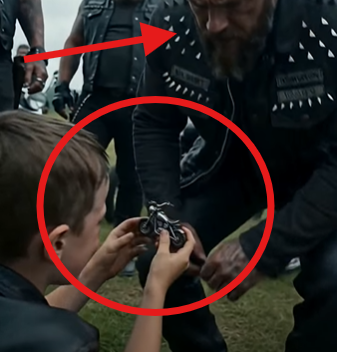
No one in the yard breathed.
Mason stayed crouched in the grass, the tiny motorcycle frozen in his hands, while the word uncle broke through him like a blade.
The little boy was crying harder now, but silently, like he had already learned some griefs only got heavier when people heard them.
Mason’s voice came out rough and almost unrecognizable.
“What’s your name?”
The child swallowed hard.
“Eli.”
That was enough to almost finish him.
Because years ago, before everything went bad, Caleb used to laugh and say that if he ever had a son, he’d name him Eli — after the grandfather who raised them both when nobody else would.
Mason closed his eyes for one second.
When he opened them again, they were wet.
“Where is your father?”
Eli pointed weakly toward the road beyond the fence.
“In our truck.”
Mason stood so fast the grass bent under his boots.
The other bikers moved too, but this time not like a gang.
Like family hearing bad news all at once.
They followed Eli across the yard, through the creaking gate, and down toward an old rusted pickup parked under a leaning tree.
The truck looked like it had driven too far on too little gas and too much pain.
Mason got there first.
And when he looked through the driver’s side window, the breath left his body.
Caleb.
Older.
Thinner.
Beard overgrown.
Face pale with sweat.
One hand still resting over his chest like he had been trying to hold himself together until the very last minute.
But alive.
Barely.
“Mason…” one of the men behind him whispered.
Mason yanked the door open.
Caleb’s eyes were half-closed, but when the air hit him, they moved.
For one impossible second, the brothers looked at each other after eleven years of silence, anger, rumors, and regret.
Caleb gave the smallest, weakest smile.
“You still hate my bike work?” he whispered.
Mason made a broken sound that was almost a laugh and almost a sob.
“You idiot,” he said. “You should’ve come to me.”
Caleb’s eyes flicked toward Eli standing barefoot in the dirt, still clutching the side of the truck.
“I did,” he whispered. “Just late.”
Mason reached in and grabbed his brother’s shoulder carefully, like he was afraid he’d disappear if touched too hard.
“What happened?”
Caleb’s breathing turned shallow.
One of the bikers was already calling for an ambulance, another running for water, another dragging open the back of a truck for supplies.
But Caleb looked only at Mason.
“They told you I sold you out,” he said.
Mason’s jaw tightened.
That old wound was still there.
Still ugly.
Caleb shook his head weakly.
“I didn’t.”
Mason froze.
Caleb swallowed through pain.
“The fire that night… I went back for the ledger before the cops got it.”
His eyes found Eli again.
“I found out too late who really took the money.”
Mason went cold.
“Who?”
Caleb looked past him to the men gathering around.
Then stopped on one face.
A biker near the back.
Silent.
Still.
Too still.
Ronan.
One of the oldest men in their circle.
One of the men Mason had trusted when Caleb disappeared.
Caleb’s voice was barely a thread now.
“Him.”
The yard changed instantly.
Every eye turned.
Ronan took one slow step backward.
The bikers who had gone silent now looked murderous.
Mason stood up slowly and turned toward him, his face empty in the most dangerous way.
Ronan lifted both hands.
“Mason, listen—”
But Eli’s voice cut through the whole moment, small and shaking and devastating.
“He told my dad if he came back, you’d kill him.”
That did it.
Not because it proved more.
Because it proved enough.
Mason looked from Ronan to his dying brother to the little boy who had carried a toy motorcycle across a yard full of strangers just to save the last piece of his family.
Then he turned back to Caleb and said the words that should have come years earlier:
“You’re home now.”
Caleb’s eyes filled.
And for the first time since he crossed into the yard, Eli stopped looking like a child begging the world not to end and started looking like a son who had actually reached the right man.