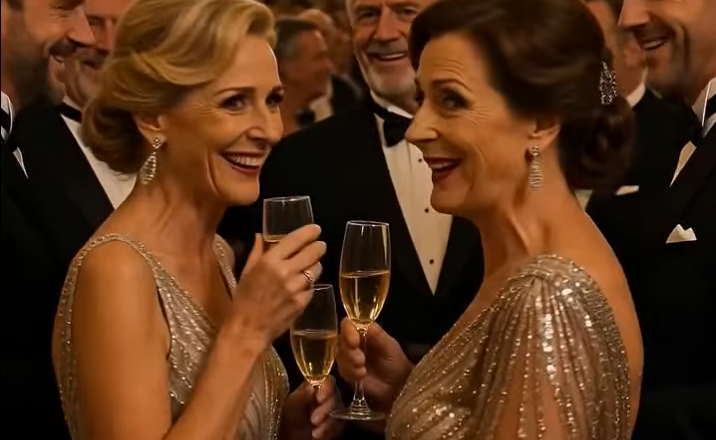
No one in the ballroom moved.
Not the guests.
Not the musicians waiting near the wall.
Not even the waiters carrying silver trays.
The little girl finished the final line of the melody with trembling fingers and sat there for one long, fragile second, breathing as if every note had cost her something.
Then she looked up.
The old man was standing right in front of the piano.
His eyes were wet.
His hand was shaking.
And for the first time since she entered that room, the little girl looked truly afraid.
The elegant woman who had mocked her earlier let out a nervous laugh. “Well. That was dramatic.”
The old man didn’t even turn his head.
He dropped to his knees in front of the child.
A gasp moved through the ballroom.
Because everyone knew who he was.
Arthur Vale.
The man who owned the mansion.
The man whose name was whispered in music halls all over the world.
The man who had not touched a piano in public since his only daughter vanished years ago.
He stared at the little silver locket, then at the girl’s face, then back at the locket again.
“Who gave you this?” he asked, but his voice was barely a voice at all.
The little girl clutched the front of her torn dress. “My mommy.”
Arthur closed his eyes for one second like the answer had struck him in the chest.
“When?” he asked.
“She told me if I got too hungry,” the girl whispered, trying not to cry, “I should find the man who knows this song.”
The ballroom seemed to tilt.
The guests looked at one another, confused now, no longer entertained.
Arthur reached very slowly toward the locket. “May I?”
The little girl hesitated… then nodded.
He opened it with trembling fingers.
Inside was a tiny faded photograph.
A younger Arthur, smiling.
And in his arms, a little girl with bright eyes and a ribbon in her hair.
His daughter.
On the inside edge of the locket, engraved in tiny letters, were the words:
For Elena. So you always come home.
Arthur broke.
Not loudly.
Not dramatically.
But in the terrible quiet way older people break when grief finally finds the exact place it was left.
His shoulders folded. His lips trembled. Tears slid down his face as he stared at the photograph.
One of the guests whispered, “My God…”
Arthur looked up at the child again, and now everyone in the room could see it — the same eyes. The same mouth. The same softness in the face.
“Where is your mother?” he asked.
The little girl’s brave expression cracked. “Outside.”
He went still.
“She’s sick,” the girl said, her words tumbling out now. “She didn’t want me to come in, but she was cold and she kept coughing and we hadn’t eaten since yesterday and she said if I played the song, maybe… maybe you’d remember her.”
Arthur rose so fast his chair behind him scraped the marble.
“Bring the car around,” he shouted.
Nobody had heard that kind of panic in his voice in years.
The same people who had laughed at the child now stepped back to clear the way.
Arthur pulled off his tuxedo jacket and wrapped it around the girl’s shoulders with shaking hands. Then, without a second thought, he lifted her into his arms like she weighed nothing at all.
The cruel rich woman who had mocked her opened her mouth as if to say something — but Arthur finally looked at her.
And whatever she saw in his face made her silent.
He carried the little girl through the ballroom, through the towering gold doors, down the front steps, and into the cold night air.
At the edge of the grand driveway, on a bench near the iron gate, sat a woman wrapped in a thin coat.
Pale.
Exhausted.
Curled inward with sickness and shame.
When she heard the doors open, she slowly looked up.
Arthur stopped walking.
Time seemed to stop with him.
“Elena,” he whispered.
The woman’s eyes filled instantly.
Older. Thinner. Worn down by life. But unmistakably Elena.
His daughter.
The one the world thought had disappeared.
The one he had spent years mourning and years being too proud to search for properly after she chose love he didn’t approve of.
She tried to stand, but nearly collapsed.
Arthur reached her first.
For one terrible second, none of them spoke. Not father. Not daughter. Not child.
Then Elena looked at the girl in his arms and said weakly, “I told you not to go in alone.”
The little girl burst into tears. “I was hungry… and I found him.”
Arthur fell to his knees in front of both of them.
His granddaughter clung to his neck.
His daughter touched his face with shaking fingers as if she still couldn’t believe he was real.
“I kept the song,” she whispered.
Arthur was crying openly now. “I heard it.”
Elena let out a broken laugh through tears. “I knew you would.”
Behind them, the rich guests had followed to the doorway, standing in stunned silence as the truth unfolded in the cold night.
They had laughed at a starving child.
And all along, she had been blood of the house.
But Arthur didn’t care about them anymore.
He looked at the little girl, then at Elena, then back at the grand ballroom behind him — all the gold, the lights, the glittering emptiness.
And for the first time in years, he seemed ashamed of everything except the two people in front of him.
He stood, helped Elena up with one arm, held the little girl with the other, and said the words that changed all three of their lives:
“Take them inside.”
Not as charity.
As family.
Later that night, the same ballroom that had laughed at the child watched in silence as a fresh plate of warm food was placed before her, while doctors were called for Elena and Arthur refused to leave their side.
And near the piano, under the chandeliers, the old silver locket lay open on the bench — no longer a mystery, no longer a memory, but a promise finally fulfilled.