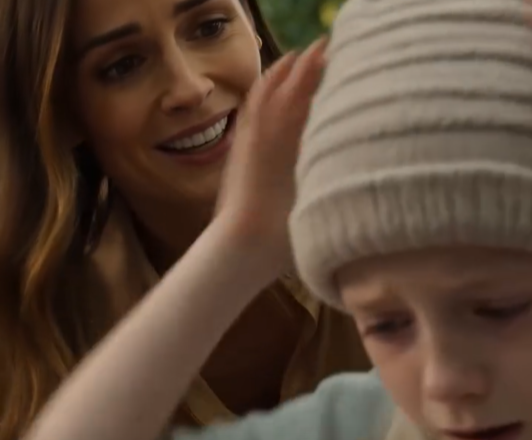
The father did not turn right away.
He stood frozen beside the wheelchair, staring at his daughter’s shaved head like his mind was refusing to accept what his eyes had already understood.
The fiancée spoke first.
“She’s emotional. You know how she gets.”
The girl flinched again.
The father saw that too.
This time, the flinch did not pass through him unnoticed.
The boy bent down, picked up the pink ribbon, and held it out.
“I found it in the trash behind your house.”
The father looked at him.
“Who are you?”
The boy swallowed.
“My mom cleans there.”
The fiancée’s face changed.
Just for one second.
But enough.
The boy kept going.
“She told me not to say anything. She said we’d lose the job.”
The girl in the wheelchair whispered, “I asked him to help.”
Her father turned to her.
Her voice was tiny now.
“I didn’t know who else to tell.”
That sentence hurt him more than shouting ever could have.
The fiancée stepped closer.
“Darling, this is becoming embarrassing.”
The father finally looked at her.
No rage yet.
Only disbelief.
“Embarrassing?”
She smiled nervously.
“She is a delicate child. She needs structure.”
The boy shook his head, crying.
“She made her practice crying.”
The park went quiet around them.
Even the distant walkers seemed to slow.
The father’s jaw tightened.
“What?”
The boy pulled a cracked phone from his hoodie pocket.
His hands shook as he opened a video.
The screen showed a dim bedroom.
The girl sitting in her wheelchair.
The fiancée standing over her with scissors in her hand.
Her voice came through clearly.
If you look sick enough, your father will never leave us.
The father’s face drained of color.
The girl covered her ears.
Not because she had forgotten.
Because hearing it again made it real.
The video continued.
The fiancée’s voice turned colder.
And when the foundation sees you, they’ll give the money early.
The father slowly turned toward her.
“The foundation money?”
She stepped back.
“You don’t understand. I was trying to protect our future.”
The girl whispered, “She told everyone I was getting worse.”
The boy added, “She took pictures after she made her cry.”
The father looked at his daughter.
At the blanket over her legs.
At the hat clutched in her hands.
At the way she had learned to become smaller so adults would not punish her for needing love.
His voice broke.
“Why didn’t you tell me?”
The girl’s eyes filled fresh.
“Because you smiled when she called me brave.”
That destroyed him.
He dropped to one knee in front of her wheelchair.
Not touching her yet.
Not forcing comfort.
Just lowering himself until he was no longer above her.
“I’m sorry.”
The fiancée tried to leave.
The boy stepped in front of her.
The father stood.
“Don’t.”
One word.
Enough.
A nanny rushed from the path behind them, phone in hand, tears on her face.
“I sent the video to your lawyer.”
The fiancée stared at her.
“You?”
The nanny looked at the girl.
“She begged me not to lose my job.”
Her voice shook.
“So I waited too long.”
The father looked at all of them.
The boy.
The nanny.
His daughter.
Every person who had been braver than him inside his own house.
Then he turned back to his fiancée.
“You wanted love to look like illness.”
His voice was quiet.
Deadly.
“But she was never the sick one.”
The girl reached for his hand.
He took it carefully.
She looked up at him with tears in her eyes and whispered,
“Can I grow my hair back now?”
The father broke.
He kissed her hand and cried into it.
“Yes.”
Then he looked at the pink ribbon in the boy’s palm.
“And while it grows, everyone will know who tried to cut her down.”