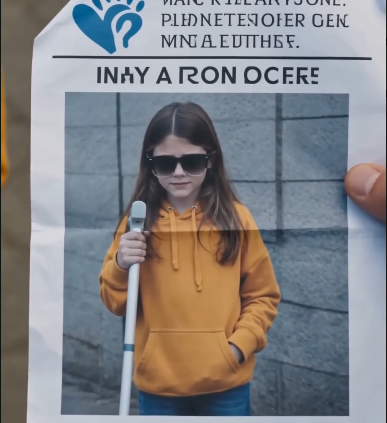
The father stared at the receipt.
His daughter’s photo was printed at the top.
His wife’s account number was at the bottom.
For a moment, he couldn’t move.
Behind him, the charity host’s voice rang through the park microphone.
“And now, please welcome the woman who gave this little girl hope…”
Applause began near the donation tents.
The wife walked toward them quickly, still smiling for the crowd, but panic had already reached her eyes.
“Give me that,” she said.
The father folded the receipt once and put it in his pocket.
“No.”
The girl gripped the white cane like she wanted to snap it, but was still scared of what would happen if she stopped holding the lie.
The boy stepped beside her.
“She made her practice falling.”
The father turned.
“What?”
The girl’s lips trembled.
His wife laughed softly.
“Children exaggerate.”
The boy’s voice broke.
“I saw it.”
He pointed toward the charity stage.
“She made her bump into chairs before donors came. She said tears raised more money.”
The father looked at his daughter.
This time, he did not ask if it was true.
He saw the answer in her shoulders.
In the way she waited to be blamed.
In the way she looked smaller whenever his wife spoke.
The host called again from the stage.
“Please come up! Everyone is waiting!”
The wife whispered through her smile, “We can talk at home.”
The girl shook her head.
Barely.
The father saw it.
And this time he listened.
He took the white cane from his daughter’s hand.
His wife’s smile vanished.
“Don’t.”
He looked at her.
“You made her carry this?”
“She needed a story people could understand.”
His voice went cold.
“She needed a childhood.”
The boy pulled out his cracked phone.
“I recorded the rehearsal.”
The wife lunged for it.
The father blocked her.
On the phone, a video began playing.
His daughter stood in the living room, sunglasses on, white cane in hand, crying softly.
His wife’s voice came through:
Look helpless. Donors don’t pay for almost blind. They pay for tragedy.
The crowd near the tents began to quiet.
The microphone was still on.
The father realized it.
So did his wife.
The host slowly lowered his papers.
The little girl began to cry.
Not because the truth was out.
Because she heard her own fear being played in public.
The father knelt in front of her.
“I’m sorry,” he whispered.
She looked at him without sunglasses.
“Will you still love me if I can see?”
That sentence broke him in front of everyone.
He took her face gently in both hands.
“I should have loved you loudly enough that no one could make you ask that.”
The boy wiped his eyes with his sleeve.
The wife backed away toward the donation table.
Too late.
People were already checking their phones.
Donors were looking at receipts.
A volunteer whispered, “The account is in her name.”
The father stood and walked to the stage, still holding the flyer.
His wife hissed, “You’ll ruin us.”
He turned back.
“No.”
Then he looked at his daughter.
“She already did that to you.”
He took the microphone.
The park went silent.
“My daughter is not blind,” he said, voice shaking. “But for months, she was forced to live like she was, so adults would give money.”
His wife covered her mouth.
The father lifted the receipt.
“This charity is frozen now. Every dollar will be audited and returned or redirected to children who were never used as props.”
Then he looked at the boy.
“What’s your name?”
“Evan.”
The father nodded.
“Evan told the truth when grown-ups made silence profitable.”
The little girl looked at Evan.
Then at the cane in her father’s hand.
“Can I throw it away?”
The father stepped down from the stage and handed it to her.
She stared at it for one final second.
Then dropped it on the grass.
No performance.
No fake fall.
No rehearsed tears.
Just a child choosing to stand in the light with her own eyes open.