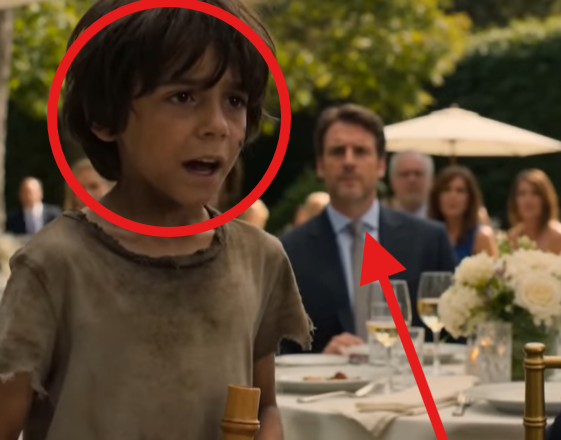
The wealthy man stared at the photograph like it had burned through his hand.
In it, a much younger version of him stood beside a woman in a simple white dress. She was smiling, holding a wooden flute between them like it was something precious.
The boy’s voice trembled.
“She said you used to play that song for her.”
The man’s lips parted, but no words came out.
The concerned woman guest leaned closer.
“Who is she?”
The man whispered, “Mara.”
The name changed the air around the table.
The boy’s eyes filled with hope.
“That’s my mom.”
The man shook his head slowly.
“No. She disappeared.”
“She didn’t disappear,” the boy said. “She said you left before you knew.”
The guests went silent.
The man looked at the child’s dirt-smudged face, then back at the photograph.
The same eyes.
The same small scar near the eyebrow.
The same melody he had written for a woman he was too proud to fight for.
His voice cracked.
“What’s your name?”
The boy held the flute tighter.
“Eli.”
The man closed his eyes.
Mara had once told him if they ever had a son, she would name him Eli.
The boy took one step closer.
“She’s in the clinic two streets from here. She told me not to beg. But she hasn’t eaten in two days because she gives everything to me.”
The wealthy man covered his mouth.
All the laughter at the table turned into shame.
The boy looked down at his torn clothes.
“She said if you were happy, I shouldn’t bother you. But then she started coughing blood this morning.”
The man stood so quickly his chair scraped against the stone.
“Why didn’t she come to me?”
The boy’s answer was quiet.
“She did.”
The man froze.
“She came to your office years ago. A woman at the front desk told her you said poor girls invent stories for money.”
His face collapsed.
“I never said that.”
The boy looked at him through tears.
“She believed you did.”
The man turned toward the elegant guests, then toward the concerned woman beside him.
For the first time, his wealth looked useless.
He placed the photograph gently on the table and knelt in front of the boy.
“I didn’t know about you.”
The boy’s lips trembled.
“But now you do.”
The man broke.
He took off his expensive jacket and wrapped it around the child’s shoulders.
“Take me to her.”
The boy looked surprised.
“To my mom?”
“To our family,” the man whispered.
The boy’s hand slowly reached for his.
And as the wealthy man walked away from the perfect luncheon, nobody saw arrogance in him anymore.
Only a man finally running toward the life he had abandoned without knowing it.