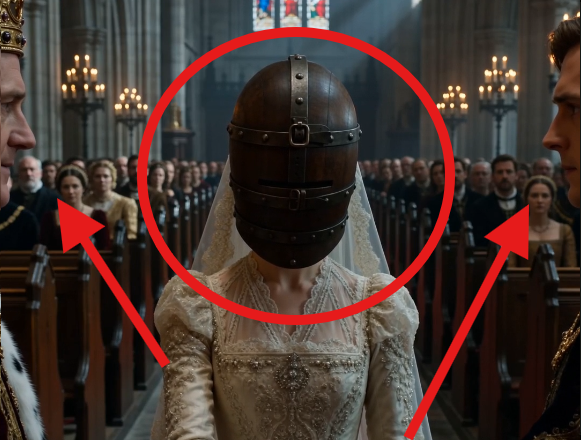
The groom’s legs nearly failed.
Inside the helmet was not the princess.
It was a frightened servant girl with tearful eyes, her mouth trembling behind the narrow opening.
The cathedral exploded in gasps.
The king’s face hardened.
“Close it.”
The groom stared at him.
“Where is your daughter?”
The servant inside the helmet began to shake.
The king stepped closer, voice low and dangerous.
“She is my daughter now.”
The groom slowly turned back to the girl.
Her breathing was broken.
“Who are you?”
The girl whispered, “Mara.”
The name meant nothing to the crowd.
But it meant everything to one old woman in the front pew.
The royal nurse stood suddenly, her hands covering her mouth.
“No.”
The king’s eyes snapped toward her.
The groom saw it.
Fear.
Not anger.
Fear.
The nurse walked forward, crying.
“That child was born in the servants’ quarters the same night the queen’s baby died.”
The cathedral went dead silent.
The king’s voice shook with rage.
“Enough.”
But Mara whispered from inside the wooden helmet.
“He made me wear it because my face looks like his.”
The groom stepped closer.
Through the small visor, he saw it now.
The same eyes.
The same mouth.
The same royal blood the king had hidden under wood because truth was uglier to him than any mask.
The nurse’s voice broke.
“He took the servant’s baby and called her cursed because she was born poor.”
Mara cried harder.
“He said no prince would marry a servant’s daughter if he could see my face.”
The groom looked at the king, disgust replacing fear.
“You were going to sell her life with your crown.”
The king lifted his chin.
“I protected the kingdom.”
“No,” the groom said. “You protected your lie.”
Then he reached up and removed the helmet completely.
Mara stood shaking in the candlelight, face wet with tears, finally seen by the room that had been ordered not to look.
The groom took her hand gently.
“I was brought here to marry a princess.”
He looked at the king.
“And for the first time today, I see one.”