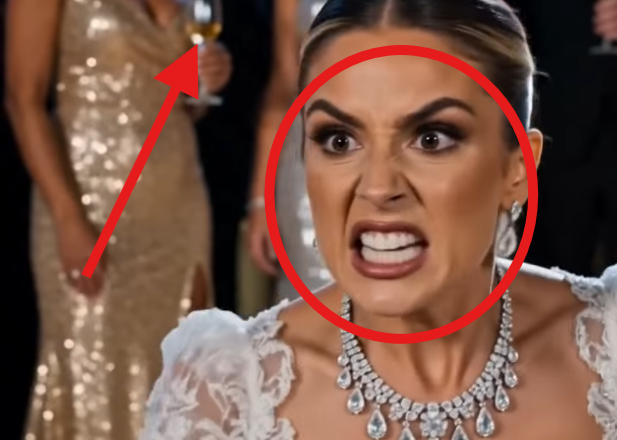
The groom stopped as if the word had struck him in the chest.
“Mother?”
The bride looked from him to Ms. Rivera, laughing too quickly.
“No. That is ridiculous. Your mother is dead.”
Ms. Rivera’s expression did not change, but her fingers closed around the diamond necklace at her throat.
“That is what his father paid everyone to tell him.”
The groom’s breath caught.
All his life, he had kept one photograph hidden in his desk: a young woman in black holding him as a baby, kissing his forehead.
His father had told him she had abandoned him before dying in poverty.
He had believed it because believing a dead mother hurt less than imagining one who chose to leave.
“You left me,” he said, his voice suddenly that of a wounded little boy. “He told me you took money and left.”
Ms. Rivera’s eyes filled at last.
“I took nothing but the clothes I was wearing.” She looked at the bride, then back at her son. “Your grandfather said if I ever came near you again, he would make sure you grew up believing I was a criminal.”
The groom shook his head.
“Why tonight?”
A distinguished man stepped onto the stage and took the microphone.
“Because tonight was never intended to be only a wedding reception,” he said. “This gala celebrates the woman whose foundation saved this venue, this hospital network, and thousands of children abandoned by powerful families.”
The screens changed.
Photographs appeared of Ms. Rivera in clinics, shelters, and schools, surrounded by children she had helped after losing the right to raise her own.
The groom covered his mouth.
His bride turned pale.
“But this is our wedding,” she stammered.
Ms. Rivera looked at her calmly.
“No. It was meant to be the night I finally met the woman my son chose.”
The bride’s eyes flickered toward the guests who had laughed with her only moments earlier.
“I didn’t know who you were.”
Ms. Rivera’s voice softened, making the words even sharper.
“That is the part you should be ashamed of. You believed I was nobody, so you thought humiliating me was acceptable.”
The bride looked desperately at her groom.
“Say something.”
He was crying now.
Not for the spoiled evening.
Not for the whispers.
For the woman who had spent his entire life loving him from a distance while he carried her picture without knowing why.
He slowly walked toward Ms. Rivera.
“Did you really keep looking for me?”
She reached into her handbag and pulled out a small worn velvet box.
Inside was a tiny silver bracelet engraved with his childhood initials.
“I bought this for your first birthday,” she whispered. “I carried it to every city I searched.”
The groom pressed the bracelet to his lips, shoulders shaking.
Then he looked toward the bride.
“You saw a woman alone and decided she deserved cruelty.”
She stepped toward him, panicked.
“I was protecting our future.”
He took off his wedding ring.
“No. You just showed me what that future would feel like.”
He placed the ring gently on the white staircase.
The bride began to sob as the guests backed away from her.
Ms. Rivera did not smile. There was no victory in watching someone lose everything in public.
Only grief for how easily kindness had been forgotten.
Her son approached her slowly, afraid he had waited too long to be held.
“I don’t know how to call you Mom,” he whispered.
Ms. Rivera’s tears spilled freely.
“You don’t have to say it tonight.”
He broke then, folding into her arms in the middle of the glowing rooftop.
She held him with both hands against his back, the way she had dreamed of doing since he was a baby.
Across the city skyline, lights shimmered against the dark sky.
And beneath them, the bride stood alone in her perfect white gown, finally understanding that the woman she had tried to throw out was not stealing her moment.
She was the family her cruelty had cost her.