Rose did not scream.
She simply sank to her knees in the dust, as if every year she had spent waiting had suddenly become too heavy for her body.
The man in the suit dropped beside her at once.
She reached for the blanket with shaking fingers.
At one corner was a tiny patch of blue thread.
She had sewn it herself the night before her baby disappeared because the blanket had torn against the rough wall of their room.
“My baby…” she whispered.
The man closed his eyes as tears ran down his face.
“My name is Thomas.”
Rose pressed one hand to his cheek.
She searched his face desperately—the shape of his eyes, the small mark above his brow, the mouth that trembled exactly the way her infant son’s had when he was about to cry.
“I called you Thomas,” she sobbed. “Before they took you, I called you Thomas.”
He folded forward into her arms.
“I know, Mama.”
The word tore through her.
For thirty years, Rose had imagined her baby cold, hungry, or dead.
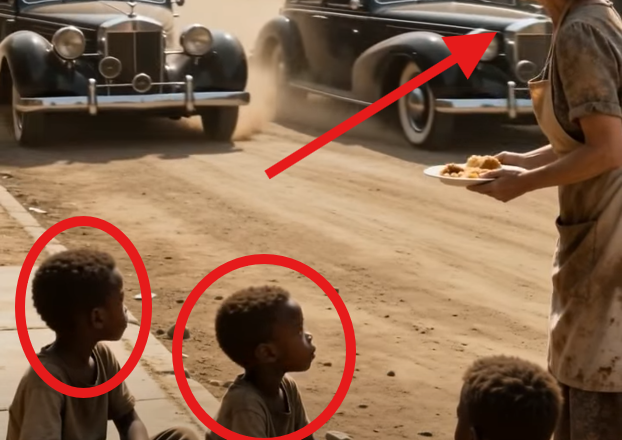
Now he was kneeling in the dirt before her, a grown man in a fine suit, crying into the same stained apron she had worn while feeding children that morning.
The two men beside him wiped their faces.
One of them spoke gently.
“We were brothers at the orphanage. Thomas shared everything with us, even when he had almost nothing.”
The other held up the dented spoon.
“He kept telling us a woman with kind eyes had fed him before his first memory faded. He never stopped searching for her.”
Rose pulled back enough to look at Thomas.
“Who took you from me?”
His face hardened with pain.
“The bakery owner’s wife. She wanted a baby, and she knew no one would fight for a poor widow’s child. She paid the landlord to tell you the state had taken me.”
Rose shook her head violently.
“I did fight. I went everywhere. I begged until people stopped opening their doors.”
Thomas caught both of her rough hands in his.
“I know now. We found the records. We found every letter you sent that was never delivered.”
Rose bent over their joined hands, crying as though her heart had finally been given permission to break.
Behind her, one of the hungry boys tugged timidly at her dress.
“Miss Rose,” he whispered, “are you leaving us?”
She turned at once.
The three children stood together near the cold pot, frightened that the only person who had shown them kindness was about to disappear into the rich men’s cars.
Rose wiped her tears quickly.
“No, sweetheart. Never.”
Thomas looked at the boys.
At their dirty faces.
At their thin arms.
At the plates his mother had filled while denying her own hunger.
His grief softened into understanding.
“You’re feeding them the way you fed us.”
Rose looked ashamed.
“They have nowhere safe to go.”
Thomas stood and removed his expensive jacket, placing it around the smallest child’s shoulders.
“Then neither do I,” he said, “unless they come too.”
Rose stared at him.
“You would do that?”
Thomas gave a tearful smile.
“Mama, you gave three hungry boys your last meal. Everything good in my life began with you.”
The smallest boy clutched the jacket closed.
“Will there be food?”
Thomas knelt in front of him.
“There will be warm beds, clean clothes, and food every day.”
The child looked at Rose for permission before daring to hope.
She pressed one trembling hand to her mouth.
For the first time in thirty years, the street no longer felt like the place where everything had been taken from her.
Thomas rose and opened his arms again.
Rose stepped into them, holding him tightly as the three boys crowded close against her skirt.
“I’m sorry I couldn’t find you,” she cried into his shoulder.
He kissed her gray hair.
“You found me first,” he whispered. “The day you fed a hungry little boy and taught him what love felt like.”
The other two men opened the car doors, not like wealthy strangers arriving to rescue someone beneath them, but like sons making room for the mother who had saved them all.
Rose looked once at her empty pot beside the ashes of the fire.
Then she gathered the children close and walked toward the cars with Thomas’s hand wrapped firmly around hers.
She had spent her whole life giving away the little she had.
At last, the love she planted in hunger had come back for her.