There, hidden behind stacked boxes and a torn plastic sheet, sat a little girl no older than five, wrapped in a thin blanket that was already wet with snow.
Her face was pale.
Her breathing was weak.
And beside her, on the ground, was an empty medicine bottle.
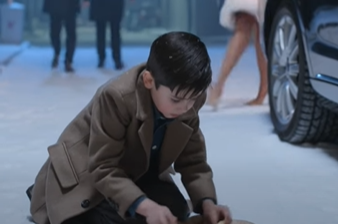
The boy ran to her with the ruined bread in his hands and dropped beside her in the snow.
He tried to smile through his tears.
“I brought the bread… I’m sorry it got cold.”
That was the moment the whole street broke.
Because suddenly everyone understood:
he had not been trying to feed himself.
He had been trying to keep his sick sister alive through one more freezing night.
A woman in the crowd covered her mouth and started crying.
Someone lowered their phone.
Another person ran toward the pharmacy on the corner.
Then the little girl looked at her brother and whispered:
“Did mom come back?”
The boy’s face collapsed.
And in a voice so small it barely existed, he answered:
“Not yet.”
The rich woman in the white fur coat stood frozen.
For the first time, she looked stripped of everything expensive.
Because now she could see what she had actually kicked into the snow:
not trash,
not dirt,
but the only food a desperate child had managed to find for his dying sister.
Then the boy looked up at her through tears and said the line that silenced everyone:
“You didn’t ruin bread… you ruined tonight.”
No one on that street forgot that sentence.
Because in that moment, the cruelest thing in the snow was not the cold—
it was a human heart with warmth all around it and none inside.