Years earlier, before the wealth fully hardened him, the dead man had fallen in love with a poor woman who worked in his family’s estate kitchen.
She became pregnant.
He promised to leave his rich world behind.
He promised marriage.
He promised the child would never grow up hidden.
But his mother found out first.
The same older woman now standing by the grave.
She threatened the poor woman.
She paid people to lie.
And she told her son that the girl had stolen money and disappeared with another man.
Then she told the pregnant woman something even crueler:
“If you ever come near this family again, I will make sure your child grows up hated.”
So the poor woman vanished and raised her daughter alone.
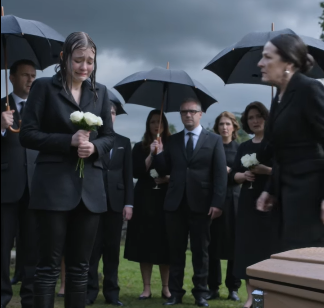
That daughter was the young woman kneeling in the mud with ruined flowers in her hands.
The teenage boy standing beside the coffin was the dead man’s “official” son.
He had found the truth only days earlier while helping clear his father’s study.
Hidden among old letters was a photograph of the poor woman, pregnant, standing beside his father.
And behind it—
a note in his father’s handwriting:
“If she ever comes here after I die, let her stand beside me. She is my daughter, whether my family accepts it or not.”
That was why the boy spoke.
He could not let her be thrown out of her own father’s funeral.
The cemetery stayed frozen as the poor young woman looked up through tears and asked the question that broke what was left of the silence:
“If he knew… why didn’t he come for me?”
No one answered.
Not because they didn’t hear her.
Because there was no answer clean enough to survive the rain.
The older rich woman’s face collapsed.
Because in front of the grave, the lie she had protected for years was now standing in black, covered in mud, mourning the same father as the son beside the coffin.
And everyone at that funeral understood the same brutal truth:
the girl they tried to erase had not come to steal grief—
she had come to bury the only father she was never allowed to claim.