I’m standing in front of a wall of glass that cost more than most people will ever earn in a lifetime, yet the view gives me no comfort.
Below me, Scottsdale, Arizona glows under the harsh afternoon sun, the kind that feels heavy enough to press straight through your bones. My office smells of polished walnut and bitter espresso.
My phone keeps vibrating with meetings I’m supposed to care about. But I’m staring at something that has unsettled me for three straight days.
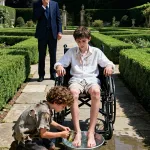
A boy—no more than ten—has appeared inside my gated garden again.
The cameras, the guards, the alarms, the entire security system I built to keep unpredictability out of my life, have failed to stop him.
He walks like he belongs here, like rules don’t apply when your purpose is simple. His shirt was once white but has surrendered to dust. His shorts are patched in a way that feels more honest than anything tailored.
But what truly doesn’t belong is what he carries: a dented aluminum wash basin, dull with age, the kind I remember from childhood kitchens, not estates with infinity pools. A heavy canvas satchel hangs from his shoulder as he heads straight toward the pool, where my son sits in his wheelchair.
Evan is eight. The last two years have aged him cruelly. His eyes used to sparkle with certainty that the world was safe. Now they rest on the ground, as if the ground is the only thing that doesn’t lie.
I’ve paid the best neurosurgeons in Phoenix, Los Angeles, and Houston. I’ve listened to conclusions delivered gently, professionally, like doors closing softly.
The spinal cord damage is permanent. My son will never walk again. I learned how to nod in public and break in private, because wealth doesn’t make grief bleed less.
The boy stops beside Evan and sets the basin down with a hollow metallic sound. He looks at my son not like a diagnosis, but like a person. His voice carries easily across the garden.
“I told you I’d come back,” he says. “My grandma said when the road disappears, you wash the feet so they remember the way.”
My fingers tighten around my desk. I want to call security. I want this to stop. I imagine Evan’s fragile hope being crushed by a child with too much imagination. Then something impossible happens.
Evan lifts his head.
For the first time in months, he looks interested.
I crack the window open. The air smells like grass and chlorine.
“Do you really think it’ll work?” Evan asks quietly.
The boy grins, one tooth slightly crooked. “I don’t think, man. I know.”
He kneels. “I’m Samuel Parker. I’m going to wash your feet, and you’re going to walk again.”
Anger flares in my chest. I rush downstairs, authority clinging to me like armor. Halfway there, I stop. My wife, Laura, is hidden behind a column, tears sliding silently down her face. She grips my arm.
“Wait,” she whispers. “Look at Evan.”
Evan reaches out—not to push Samuel away, but to accept him.
Samuel pours warm water into the basin, adds rosemary, basil, coarse salt. The scent pulls me backward into memories I forgot I missed. The garden stops feeling staged.
“What’s going on here?” I demand.
“I’m helping your son,” Samuel replies calmly.
I warn him this is private property. He nods. “Doctors see machines,” he says. “My grandma saw roots. Evan isn’t broken. He’s disconnected.”
My stomach tightens. I’ve used that word myself.
“Dad,” Evan says softly. “Please. It’s the first time I feel something.”

Samuel works gently, humming. He tells us about his grandmother Grace Parker, who healed people clinics abandoned. When Laura asks where she is now, his voice wavers. “She passed on,” he says. “But she left me her hands.”
Suddenly, a man climbs over the wall, furious and out of breath.
“Samuel!” he shouts. “How many times—”
He freezes when he sees me. “I’m Michael Parker. His dad. He just… helps.”
I look at Michael’s cracked hands and realize how rarely I’ve looked long enough to see men like him.
“Don’t worry,” I say. “Your son made mine smile.”
That night, Evan touches his feet like they might disappear.
“Samuel says they’re just sleeping,” he tells me.
“I don’t know,” I admit. “But we’ll try believing.”
I cancel meetings. Samuel returns every afternoon. Evan waits beneath the old oak tree—the same one he fell from. Laura brings lemonade. Guards open the gate. Evan practices standing. I try to pay Samuel. He refuses.
“Gifts rot if you sell them,” he says.
Then one afternoon, Evan’s toe moves. Not a spasm. A choice.
Authorities arrive later. I stand between them and my son. Samuel kneels beside Evan.
“This part is yours,” he says.
Evan stands. Then he walks.
Hope spreads. Families gather. A young neurologist, Dr. Natalie Brooks, names what she sees: neuroplasticity. We build a center. Science and tradition sit together. Years pass.
Ten years later, Evan and Samuel graduate medical school side by side.
Back under the oak tree, Samuel sets down the dented basin.
“The miracle wasn’t the water,” he says.
Evan nods. “It was someone believing.”
I finally understand. The miracle climbed my wall and forced me to admit that control is not safety. The richest thing I own now is the story of a boy who reminded my son—and me—that sleeping paths can wake again.