Not the fiancée.
Not the son.
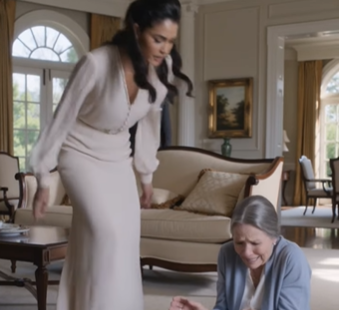
Not even the elderly mother still kneeling among the broken porcelain.
Only the sound of her unsteady breathing could be heard.
The older man set the leather file case on the table and looked directly at the son.
“Help your mother up.”
This time, he moved.
The son rushed forward, knelt beside her, and carefully lifted her from the carpet.
Her hands were still shaking.
A tiny cut on one finger had started to bleed.
She looked smaller than anyone in the room had ever seen her.
The fiancée tried to speak first.
“I think there’s been some misunderstanding—”
The older man turned to her.
“No,” he said.
“The misunderstanding is yours.”
He opened the stamped envelope and pulled out several legal documents.
“Your late husband,” he said to the mother, “did not leave this house to be divided by pity, pressure, or marriage.”
The son went pale.
The fiancée’s face tightened.
The older man lifted the first page.
“He named me executor because he feared exactly one thing,” he said.
“That after his death, the woman who stood beside him for forty years would be treated as if she had to earn the right to remain in her own home.”
The room fell silent again.
The elderly mother covered her mouth.
Tears came harder now—but these were different.
The older man read aloud from the document:
If my wife is humiliated, threatened, displaced, or forced into servitude under this roof, my executor is to suspend all benefits, inheritance expectations, and residential privileges of every person responsible, including my son if he stands by in silence.
The son staggered back as if struck.
The fiancée went white.
“That’s impossible,” she whispered.
The older man pulled out a second page.
“No,” he said calmly.
“This is notarized, witnessed, and legally binding.”
The son looked at his mother with shame flooding his face.
“Mom…”
But she couldn’t answer.
She was crying too hard.
The older man continued:
“The estate remains under protective control until I am satisfied that she is treated as the legal and moral head of this household.”
Then he looked straight at the fiancée.
“And from what I have just seen, you will not remain in this house long enough to test that clause twice.”
The fiancée stepped backward.
For the first time, her arrogance cracked.
“He wouldn’t do that to his own son.”
The older man’s eyes shifted to the son.
“He already did.”
He lifted the final paper.
“Because he knew a man who watches his mother kneel may not deserve to inherit the chair she once stood behind.”
The son’s face collapsed.
The room went completely still.
Then the older man turned to the elderly mother and softened his voice.
“You were never meant to kneel here.”
Her tears spilled over again.
The son lowered his head.
The fiancée had nothing left to say.
And the older man delivered the final blow:
“From this moment, she decides who remains under this roof.”
The mother looked around the room, still trembling, still wounded, but no longer powerless.
Then, with tears on her face and her voice barely steady, she said:
“Take the broken tray out… and then take her with it.”