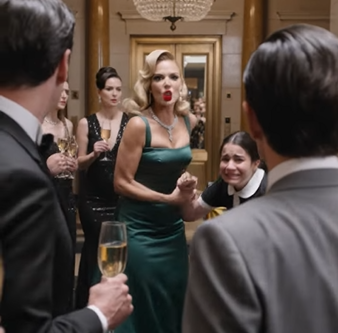
Only the soft hum of the chandeliers and the maid’s unsteady breathing could be heard. The glamorous woman in the emerald gown, who had filled the room with accusation only seconds earlier, now looked as though the ground beneath her had shifted. Her confidence did not vanish all at once; it cracked visibly, piece by piece, under the weight of the brooch in the hotel owner’s hand. Around them, guests kept their phones raised, but no one was smiling anymore. What had begun as public humiliation was turning into something far more dangerous — exposure.
The owner did not rush. Men like him never did. He let the silence work for him, then explained that the brooch had not been found in any servant corridor, housekeeping cart, or staff locker. It had been recovered moments earlier by hotel security during a discreet check of a private suite upstairs — a suite registered not to the maid, not to any hotel employee, but to the fiancé of the woman now making accusations in the middle of his lobby. That alone would have been enough to stop the scene. But the expression on his face made it clear there was more, and everyone in that marble hall felt it.
The maid slowly looked from the brooch to the woman in green, unable to understand what she was hearing.
“My fiancé?” the woman repeated, but the force in her voice was gone now. “That makes no sense.”
The owner’s gaze sharpened.
“It makes perfect sense,” he said. “Especially when the suite camera shows he was not alone when the brooch disappeared.”
A murmur rippled through the guests.
The woman’s face changed.
And in that instant, the maid understood something before the crowd did: this was never really about a stolen brooch. The shouting, the grabbing, the public bag search — all of it had been too fast, too aggressive, too theatrical. The rich woman had not merely wanted the maid blamed. She had wanted the blame fixed instantly, before any other story had time to breathe. That realization hit the maid so hard she forgot, for a second, to cry.
The hotel owner continued, each word calm and devastating. He said security had flagged unusual movement on the VIP floor earlier that evening. A man exiting the suite. A woman entering moments later through the service corridor. A brief struggle over something small and reflective. Then the same man — the fiancé — seen placing an item into a velvet case before security intercepted him downstairs. When confronted, he denied everything at first. But the owner, who had spent decades watching the wealthy lie with polished faces, said denial rarely survives evidence for long. In the end, the man admitted only one thing: that he had wanted to “avoid a scandal.”
A bitter irony passed through the room.
Because now scandal was all anyone could see.
The woman in the emerald gown tried to recover herself, tried to stand taller, tried to speak with the authority she had carried at the beginning. But her voice betrayed her. She insisted her fiancé would never steal, never hide, never place her in such a position. The owner listened without interruption, which somehow made it worse. Then he said the words that changed the atmosphere completely: the brooch was not valuable merely because of its diamonds. It was a family piece on private loan to the hotel for the gala, and only a handful of guests had known that. Her fiancé had known. She had known. The maid had not.
That detail moved through the crowd like ice.
Now the accusation looked exactly what it was — not instinct, not outrage, but calculation.
The maid stood very still among the spilled bottles, cloths, and scattered supplies from her ruined cart. Her humiliation was still visible on her face, but something else had joined it now: clarity. She looked down at the small photo on the floor — the one that had fallen from her bag when the rich woman tore it open. It showed an elderly mother and a little boy standing beside her in front of a gray apartment block. A private life. A fragile dignity. Both had been thrown across black marble for entertainment. And suddenly the entire hotel lobby, with all its chandeliers and champagne and polished cruelty, seemed far uglier than before.
The owner bent, picked up the photo carefully, and handed it back to her.
That small gesture did more to shame the room than any shout could have done.
Then he turned to the woman in green and asked whether she would like him to continue — whether he should explain why her fiancé’s suite mattered even more than the guests yet understood. She did not answer. Her mouth opened, but nothing came out. So he went on. The suite, he said, had been paid for not by the fiancé, but through an account linked to her own family office. And according to the booking notes, the man had been staying there privately for three nights under special instruction that his presence not be added to the public gala list. That meant secrecy. Pre-arrangement. Planning. Not panic.
The guests stared openly now.
The woman’s eyes filled not with tears, but with fear.
Then came the final blow.
The owner revealed that the maid had been assigned to that floor only at the last minute because another staff member had gone home sick. In other words, she could not have been the intended target from the start. She was simply convenient. Young enough to overpower. Poor enough not to be believed. Invisible enough to destroy. The accusation had attached itself to the easiest victim in the room the moment something went wrong upstairs.
The maid looked at the woman as if seeing her for the first time.
Not as a guest.
Not as power.
But as cowardice dressed in emerald silk.
The owner’s voice lowered further as he said that one more thing had been found in the fiancé’s suite: a handwritten note on hotel stationery, half-crumpled beside the brooch case. It contained only one line, but it explained everything. He had not planned to read it aloud. After witnessing what had just happened in his lobby, he changed his mind.
He unfolded the note and read:
If anyone asks, blame the maid. No one will question it.
A sound escaped the crowd — not quite a gasp, not quite disbelief, but something uglier.
The woman in the emerald gown went white.
The maid stopped breathing for a second.
Because no matter what defense came next, no matter what excuse, no matter how loudly someone shouted about misunderstanding or betrayal or panic, the truth was already standing in the center of the room. She had not just been accused. She had been chosen.
The owner stepped aside then, as though even he understood the next moment no longer belonged to him.
The young maid, still shaking, still tear-streaked, slowly lifted her eyes to the woman who had dragged her by the wrist and torn apart her bag in front of strangers.
And in a voice so broken it made the whole marble lobby feel suddenly small, she asked:
“You didn’t think I was guilty… did you?”
She swallowed.
“You just thought no one would care what happened to me.”