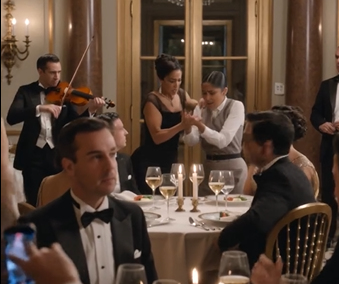
The candles still burned. The violinist still stood with his bow suspended in the air. Waiters remained frozen beside polished service stations, and the guests who had begun recording no longer looked entertained. What had started as a glamorous scandal — the kind of cruel public accusation wealthy people often assume they can survive with nothing more than confidence and volume — had shifted into something far more dangerous. The balance of power in the room had changed, and everyone felt it at once.
The young hostess stood in the center of it, tears bright on her face, her hands still half-open from the humiliation of being forced to prove she was not a thief. She looked from the businessman to the ring to the woman in black, as if her mind could not decide which shock to process first. The woman accusing her, who only moments earlier had been all certainty and contempt, now looked as though someone had reached inside the evening and pulled a hidden thread loose. Her authority had not vanished completely, but it had cracked.
The businessman did not raise his voice. He did not need to. He explained that the ring had not been found under a chair, beneath a napkin, inside a restroom, or anywhere near the hostess stand. It had been discovered inside a clutch bag left in the private dining room by the accuser’s younger sister — the same sister who had arrived late to the dinner and had spent nearly twenty minutes behind closed doors with the family before the accusation erupted outside. The location of the ring was already humiliating enough. But what mattered more, he said, was why the ring had been there at all.
A murmur moved through the tables.
The woman in black shook her head immediately.
“That proves nothing,” she said, but the old force was gone from her voice. “My sister would never—”
The businessman cut across her with a calmness more brutal than shouting.
“Would never hide the engagement ring of the man she was privately meeting?”
That sentence changed the room.
Now the silence was no longer confused. It was charged.
The hostess, who had been reduced moments earlier to a sobbing girl being publicly searched by someone richer than her, slowly lowered her hands and stared at the woman in black in open disbelief. The accusation suddenly looked too fast, too loud, too carefully aimed. It had not come from evidence. It had come from panic. And panic, in rooms like that, usually meant somebody was trying to get ahead of the truth before the truth learned how to speak.
The businessman continued, and with every word the picture sharpened. He said the ring had gone missing only after an argument inside the private dining room — an argument overheard partially by staff, involving broken promises, family pressure, and a sister who had become “too close” to someone she should never have touched. The engagement dinner had not been as perfect as the restaurant floor had assumed. Behind those doors, while the candles glowed and the wine was poured and the violinist played for the guests outside, something rotten had already been happening. The missing ring was not the beginning of the scandal. It was merely the moment the scandal spilled into public view.
The woman in black tried to recover. She tried to insist that the hostess had still behaved suspiciously, that she had looked nervous, that she had been standing too near the table. But even as she spoke, her words sounded thinner, more desperate. Because now everyone could see what she had seen the moment the ring was found elsewhere: if the spotlight stayed inside her family for even one more minute, all the expensive beauty of the evening would collapse under what was really taking place. So she had done what frightened powerful people often do. She had chosen the weakest person in sight and handed the blame to her before anyone could ask harder questions.
The hostess’s breathing began to steady.
Not because she felt safe.
But because she finally understood.
She had not been accused because she looked guilty.
She had been accused because she looked disposable.
That realization moved through the room just as clearly as any confession.
The businessman then revealed the detail that turned humiliation into something darker still. The sister’s clutch had not only contained the ring. It had also contained a folded note in the fiancé’s handwriting. He had not intended to expose it publicly. But after walking out and seeing a crying employee being manhandled in the middle of his dinner, he changed his mind. He unfolded the note and read aloud only the single line that mattered:
After tonight, she will have to accept it. We can finally stop pretending.
The guests inhaled sharply.
The words were devastating precisely because they were so clear. There was no mention of theft because there had been no theft. There had been betrayal. The ring had left the table not through the hands of a poor hostess, but through a private arrangement between people who were never supposed to be caught. And the public accusation that followed had not been grief or outrage. It had been damage control wearing couture.
The woman in black went pale enough that even the candlelight could not warm her face. For the first time since the scene began, she looked not furious, but cornered. The businessman held her gaze and said, with a control that made the entire restaurant lean into the moment, that her engagement had not been shattered by a hostess, a missing ring, or a misunderstanding. It had been shattered inside her own family before she ever laid hands on an innocent employee. Then he added one final detail: the hostess had not even been assigned to that part of the dining room until ten minutes before service, after another staff member had switched sections. Which meant the accusation had not been rooted in suspicion from earlier in the night. It had been improvised. Opportunistic. Cruel.
The young hostess looked down for a second, fighting one last wave of emotion. Scattered across the polished floor beside her were the remains of the evening that had just been torn apart — a dropped reservation card, a fallen linen napkin, a glass someone had set down too hard. But she was no longer shrinking under the eyes of the room. Her tears were still there, yes, but they no longer belonged to helplessness alone. Dignity had begun to return, and that made her harder to look away from than any diamond in the restaurant.
The businessman turned to her then, and unlike everyone else that night, he looked at her as though she had not existed merely to absorb someone else’s panic.
“You were owed an apology before any accusation,” he said.
But the apology did not come.
The woman in black could not seem to make her mouth form it.
Because the truth had trapped her more completely than guilt ever could. If she apologized, she admitted what she had done. If she stayed silent, the silence admitted it for her.
The hostess lifted her eyes at last and looked directly at the woman who had grabbed her hands and tried to pry them open under candlelight while strangers filmed.
When she spoke, her voice was soft — but in that silence, it cut through the whole room.
“You didn’t think I took your ring,” she said.
Her throat tightened, but she kept going.
“You just needed someone smaller than you to break first.”