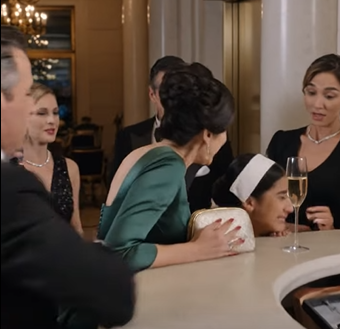
The chandeliers still burned overhead. The quartet stood frozen with their instruments half-lowered. Guests held their phones and champagne glasses in the same suspended silence, as if no one trusted their own body to shift before the truth did. Only the maid’s breathing could be heard clearly — uneven, frightened, still catching up to the violence of being shoved against polished wood and publicly torn open in front of strangers. Just moments earlier, the entire scene had seemed horribly simple: a rich woman screaming, a poor maid crying, a missing brooch, and a crowd ready to accept the easiest explanation. But now the brooch was no longer missing, and the story everyone had been so willing to believe was beginning to rot from the center.
The maid slowly looked down at the scattered contents of her service bag. Cloths. Gloves. A keycard sleeve. The small bent photograph that had slid into the open — an older woman and a child smiling under cheap daylight somewhere far from chandeliers and marble. Such ordinary things. Such vulnerable things. They now lay exposed beneath gold light and elite silence because someone wealthier had needed a body to pin blame to before the real scandal emerged. That realization had not fully reached her yet, but it was moving toward her quickly, one breath at a time.
The hotel owner did not rush. He said the brooch had not been found in a housekeeping cart, service corridor, staff locker, or laundry chute. It had been recovered minutes earlier in a private suite upstairs — a suite not assigned to any maid, attendant, or hotel employee, but to the fiancé of the woman now standing speechless in the middle of his lobby. Security had entered only after a member of his team noticed irregular movement on the VIP floor and alerted him quietly. What they found was not confusion. It was concealment.
A murmur moved through the guests.
The woman in emerald tried to regain her voice.
“That proves nothing,” she said, though her certainty was already gone. “He must have picked it up by mistake.”
The owner looked at her as though the lie bored him.
“In a locked velvet watch box?” he asked.
The room tightened.
He explained that the brooch had been found tucked inside a compartment in the fiancé’s suite, beneath a set of cufflinks and a folded dinner program from the gala. Not dropped. Not overlooked. Hidden. And that alone would have been scandal enough for a private conversation later. But the moment he stepped out of the elevator and saw an innocent employee physically cornered, searched, and humiliated in front of the entire lobby, the matter stopped being private. At that point, he said, the truth belonged to witnesses.
The maid stared at him, then at the woman in emerald, then back at the brooch.
Something in her face changed.
Because suddenly the accusation no longer looked like outrage.
It looked prepared.
Too fast.
Too certain.
Too eager to become public before anyone could ask a harder question.
The owner continued in the same low, controlled tone. Security footage from the VIP corridor showed the fiancé entering his suite with the brooch less than ten minutes before the accusation began downstairs. More importantly, he had not entered alone. He was seen arguing with a woman just outside the door — the same woman now standing in the lobby in green silk, who had moments later rushed down and created chaos before anyone else connected the timing. The maid had not taken the brooch. She had simply been the nearest powerless person when panic needed a target.
That landed harder than any shout.
Around the lobby, guests who had lifted their phones for scandal were now recording something far uglier: not theft, but selection. The rich do not always accuse the most likely person. Often, they accuse the person least able to survive it.
The woman in emerald turned pale enough that even the chandelier light could not flatter her.
“You don’t understand,” she said. “You have no idea what he’s done.”
The owner’s expression remained cold.
“Then perhaps you should have confronted him,” he said. “Instead of trying to destroy her.”
The maid lowered her eyes for a second, and when she looked back up, there was still pain in them — but no longer only pain. Clarity had started to settle. She had not been searched because anyone believed the evidence pointed to her. She had been searched because her tears were safer than another rich woman’s humiliation. She had been thrown against a desk because she wore a uniform, because she carried a service bag instead of a surname, because people in rooms like that often assume working girls can be broken quietly and forgotten quickly.
The owner then revealed what made the whole scandal even worse. The fiancé had not simply hidden the brooch. According to the partial exchange caught on corridor audio, he had been trying to stop the woman in emerald from entering the suite because another woman had just left it moments before. That was why the argument began. That was why the brooch came off. That was why panic spread. The gala engagement everyone thought they were watching unravel in whispers had already collapsed upstairs before a single shout was heard below. And rather than let the truth about betrayal reach the lobby first, the woman in emerald had chosen a faster story — theft, poverty, guilt, a maid in tears.
A guest near the reception desk slowly lowered her phone.
Then another.
Because once cruelty reveals its true shape, even witnesses begin to feel contaminated by having watched it.
The owner bent, picked up the fallen photograph from the marble floor, and handed it back to the maid with quiet care. It was the smallest gesture in the room, and yet it changed the atmosphere more than anything else had. For the first time since the scene began, someone had treated her as a person instead of a surface for scandal.
Then he looked back at the woman in emerald and said there was one final detail. When security searched the fiancé’s suite, they found not only the brooch, but also a torn page from hotel stationery in his handwriting. He had no intention of reading it aloud. After seeing the maid shoved against a desk while strangers filmed, he changed his mind. He unfolded the note and read one line:
If she finds out tonight, blame the maid before she speaks to anyone.
The lobby seemed to stop breathing.
The maid closed her eyes for one brief second.
Because now there was no mystery left, only brutality.
Not only had she been falsely accused.
She had been chosen in advance as the easiest life to damage.
The woman in emerald looked as if she might fall, but the owner did not move toward her. Neither did the guests. Sympathy had left the room. All that remained was exposure. Whatever pain had driven her into panic upstairs no longer excused what she had done downstairs. Betrayal may have wounded her, but it was cruelty that had guided her hands.
The maid, still shaking, slowly straightened her posture. Her face was wet, her bag was ruined, and her private things still lay half-scattered across polished marble. But the helplessness that had filled her at the beginning was no longer the only thing visible. Something steadier had returned — dignity, thin but unmistakable.
When she finally looked at the woman who had shoved her and called her a liar under chandelier light, her voice was soft enough to force the whole lobby into listening.
“You never thought I stole it,” she said.
Her fingers closed around the photograph.
“You just needed someone smaller than your heartbreak.”