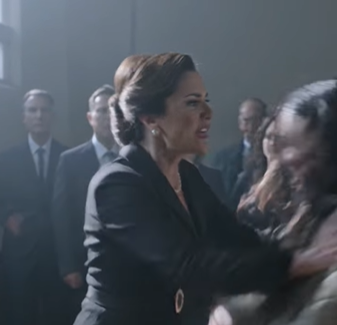
The wind still shifted the black coats of the mourners. Cold daylight still lay flat across the stone paths and wreaths. The priest stood silent beside the coffin, and even the men ready to carry it seemed uncertain whether they were now part of a burial or the opening of something that had been dead in paperwork only. Moments earlier, the widow had controlled the scene through status, grief, and outrage. She was the wife. She was the one with the surname, the black gloves, the official place beside the coffin. The poor woman had looked easy to dismiss — soaked, trembling, out of place, the kind of person wealthy mourners assume is either dramatic or disgraceful. But once the key touched the coffin, that hierarchy cracked.
The older man still held the key in his palm as if it might burn him.
He explained, with visible hesitation, that years ago — long before the widow, before the business empire, before the polished public image of the dead man became fixed in newspapers and gala photographs — there had been another name. Not a nickname. Not a youthful mistake. Another legal identity under which he lived, worked, and signed documents before a catastrophic disappearance severed him from that life. Few people knew the full history. Fewer still were willing to say it out loud. The key in his hand was engraved with the initials from that original identity, along with the number of a private bank safe box that should have been emptied decades ago.
A shiver moved through the mourners.
The widow stared at him as though the coffin itself had just lied to her.
“What are you saying?” she asked. “That my husband wasn’t even who he said he was?”
The poor woman answered before the older man could.
“I’m saying he became your husband after he stopped being someone else’s.”
That sentence changed the air.
Because now this was no longer simply about affairs, hidden grief, or a secret safe.
It was about replacement.
Reinvention.
A whole life built on whatever came after another one was abandoned.
The poor woman said she met him not as the elegant man everyone here knew, but as the frightened one who still woke up in the night speaking a different name. He told her things slowly, in fragments, always halfway to confession and halfway back into denial. He said the old safe held “the proof of what was taken when he became respectable.” She did not understand at first whether he meant money, documents, or a person. Near the end of his illness, when the fear of dying made him more honest than comfort ever had, he finally gave her the key and said if he died before opening the safe himself, she must bring it to the funeral — because that would be the only place his two lives could no longer avoid each other.
The widow looked sick now.
Not only because of the secret.
Because of the insult buried inside it.
A dying man had trusted another woman, not his wife, to bring the final truth to his coffin.
The older man spoke again, more quietly this time. He said the dead man once belonged to another city under another surname, and under that first identity he had been married before — not publicly in high society, not with photographers or business pages, but legally, privately, and very young. That marriage ended not with divorce, but with disappearance after a fire, a debt collapse, and a set of legal irregularities the family spent years suppressing. Officially, that man died. Unofficially, he survived and started over under the name the widow later married.
The mourners no longer looked merely scandalized.
They looked contaminated.
Because if that was true, then the widow was not simply hearing that her husband kept secrets. She was hearing that her entire marriage might have rested on a name that was never clean to begin with.
The poor woman’s face was wet with tears, but she kept going. She said he was never brave enough to undo his own reinvention while he was alive and admired. He loved the power, the money, the distance from what came before. But he also feared the safe, because inside it was everything he used to become someone else: old identity papers, letters from the first years, a marriage certificate under the original name, and one signed statement meant to be released only after death. She knew this because he told her what was there on the final night she saw him conscious, and because he made her repeat the safe number back to him until he believed she would not lose her nerve.
The widow’s voice came out thin and strange.
“And why you?” she asked.
That was the question everyone wanted answered.
The poor woman lowered her eyes briefly to the coffin, then back to the widow.
“Because I knew the man he became,” she said. “And I was the only one he trusted to expose the man he used to be.”
That answer cut deeper than accusation.
Not because it sounded romantic.
Because it sounded like judgment.
The older man turned the key over again and said there was one more detail engraved on the reverse side — not just initials, but a date. He read it aloud. It was the same date as the first legal identity’s marriage filing. The widow visibly lost balance for a second and had to catch herself on the coffin stand.
Now the safe no longer looked like a cache of money or blackmail.
It looked like a tomb with documents in it.
The poor woman said he told her the statement inside the safe explained why he never let anyone from his second life ask too many questions about the first. He had not merely changed names for convenience. He had changed names because someone else took the blame for something he survived. Someone with less money, less power, less chance of ever clearing their name. He said he spent years pretending that becoming important was the same as becoming innocent.
That line moved through the funeral like ice water.
The widow whispered, “No…”
But she did not say it with conviction.
She said it like someone realizing the shape of her ignorance in public.
The older man then revealed what made the whole thing worse. He remembered the original case. He remembered the rumors. A warehouse fire. Missing funds. One man listed dead. Another man imprisoned. If the dead husband truly was living under the identity of the “dead” man from that file, then the safe did not simply contain private shame. It contained the surviving half of a crime.
All eyes turned back to the coffin.
It now seemed almost obscene that flowers were still arranged on it.
The poor woman stepped closer and laid her hand gently on the coffin lid. She said he begged her not to come while he was alive because he could still manage the lie then. At the funeral, he said, the lie would finally be weak enough. The rich mourners, the widow, the priest, the family friends — all of them would be forced to hear the truth with his body in front of them and no future left to bargain for.
That was why she came.
Not to beg.
Not to claim widowhood.
Not to perform grief.
To place the key back on the man who carried it too long.
The widow was still breathing too fast now, eyes fixed on the key in the older man’s hand.
“You’re saying my husband had another name,” she said. “Another marriage. Another life.”
The poor woman looked at her with a sadness that was somehow harsher than anger.
“I’m saying,” she answered, “that the man you buried spent years making sure nobody opened the first grave.”
One by one, the phones lowered.
No one wanted to look like they were filming gossip anymore.
Because the funeral had become something else: not the mourning of a husband, but the collapse of an identity.
When the poor woman finally lifted her eyes to the widow again, her voice was soft enough to make the entire graveside strain to hear it.
“You shoved me because you thought I came here to shame you,” she said.
Her gaze dropped once to the key, then returned to the widow.
“I came because he died before he could tell you whose name was already dead when you married him.”