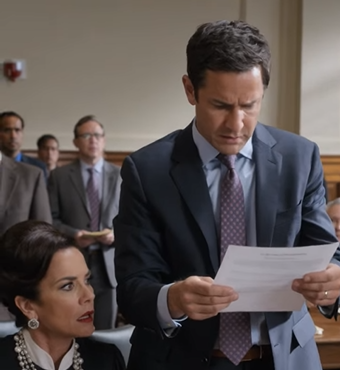
Daylight still poured through the tall windows. The judge remained frozen with one hand half-lifted above the bench. Reporters kept their phones raised, but the mood had changed so completely that no one looked excited anymore — only stunned. A moment earlier, the room had been ready to watch a familiar humiliation: a rich widow destroying a poorer young woman in public, dismissing her as another opportunist crawling toward a dead man’s fortune with a manufactured story. But the DNA report had split that certainty open. The poor young woman was not lying. Worse for the widow, the truth was even larger than anyone had expected.
The young woman stood beside the table trembling, one hand still clenched after throwing the report. She looked humiliated, angry, frightened — all at once. But underneath it now was something steadier: vindication arriving in the worst possible place. Not privately. Not gently. Not in the quiet dignity of a sealed legal office. In a courtroom. In front of cameras. In front of the widow who had just dared her to prove herself. The same proof meant to erase her had made her real.
The widow slowly turned toward the crowd, scanning faces as if the second child might somehow be visible by instinct alone. Her expression had changed from contempt to confusion to something much closer to fear. Because one hidden daughter is a scandal. Two hidden children is a structure. It means the dead man did not make one private mistake. He built another life behind the public one, maybe several.
The lawyer looked back down at the report, then at the estate file, trying to steady himself through procedure. He explained that the DNA results had been prepared in connection with the young woman’s petition, but attached to the lab findings was an internal note referencing a second tested match already in the system. Same father. Different mother. Different filing date. The second child had not been added yesterday, or after the funeral, or as part of this girl’s claim. The second child’s information had already existed in confidential probate preparation materials before the widow even entered court that morning.
That landed over the room like a blow.
Because now the widow was no longer just hearing that her husband had betrayed her once.
She was learning that he had prepared legally for this.
The young woman stared at the lawyer.
“You mean… he knew?”
The lawyer answered carefully.
“He knew enough to have this documented.”
A murmur spread through the gallery.
The widow’s voice came out thin and sharp.
“Who is it?”
But no one answered immediately, because the implication was hitting everyone at once. If the second child was already listed in estate preparation materials, then the late husband had not simply fathered children in secret. He had taken steps — private, quiet, strategic steps — to account for them after his death. He may not have had the courage to acknowledge them while he was alive, but he had enough fear to leave paperwork behind. That kind of hidden order is always worse than chaos. Chaos can be denied. A paper trail cannot.
The young woman said her mother had spent years being told she imagined everything. That rich men sometimes make promises, yes, but promises are not names, and names are not inheritance. She grew up hearing that she should expect nothing public, nothing formal, nothing traceable. Her mother cleaned houses. Worked extra shifts. Stayed away from the family’s part of town. Yet just before he died, the man summoned her once — only once — and handed over a sealed packet with a single instruction: If they mock you, file everything at once. Do not come alone. At the time, her mother thought it was guilt. Now, in the courtroom, it looked more like fear that his widow would behave exactly as she just had.
The widow’s head snapped toward the girl.
“So he prepared you too?”
The girl met her eyes.
“No,” she said. “He prepared for you.”
That line changed the room.
Because it made the widow’s public humiliation of her look less like righteous anger and more like the predicted reaction of a house built on denial.
The lawyer then clarified the most dangerous detail of all: the second child was not mentioned casually in some side note or unverified claim. The child’s name appeared in a codicil reference index tied to contingent distribution review. In plain English, he said, the estate had already been quietly flagged for possible revision if paternity documentation became public. The widow did not understand the legal language immediately, but the judge did. So did the reporters. It meant the dead man’s advisors had been bracing for this possibility.
The widow sat down without meaning to.
That was the first honest thing her body had done all morning.
The courtroom watched her, then watched the lawyer, then began turning toward the gallery row by row, exactly as she had, trying to find who else might be sitting there carrying the dead man’s face under another surname.
The young woman looked toward the benches too, breathing unevenly now. Vindication had not made this easier. It had made it bigger. She came prepared to prove she was his daughter. She had not come prepared to learn she had a sibling hidden in the same silence.
The widow whispered again, more to herself than anyone else:
“Who is it?”
This time the lawyer did not answer immediately because his eyes had found someone.
A man near the back row.
Not a child — not young at all, in fact. Late twenties, maybe older. He had been standing against the wall beside the reporters, dressed plainly, saying nothing, watching everything with the frozen expression of someone hoping the truth would stay theoretical long enough for him to slip out unseen.
That alone changed the scandal again.
Because the second child was not a surprise infant, a mistress’s baby, or some conveniently distant rumor.
It was an adult.
Old enough to know.
Old enough to wait.
Old enough to understand exactly what this courtroom had just become.
The widow followed the lawyer’s gaze slowly.
When she saw the man by the wall, all the blood left her face.
Not with recognition of him, perhaps — but with recognition of what he represented.
Duration.
This secret was not recent.
It was not one affair.
It was not one lapse in judgment.
It had lasted years.
The man near the wall did not step forward at first. He looked as if he hated every second of being seen. Then, finally, he said the one sentence that finished what the DNA report had begun.
“He paid my college tuition through a trust that used someone else’s name.”
The courtroom broke into noise again.
The judge shouted for order. Reporters started talking over one another. Cameras rose higher. But beneath all of it, the emotional truth had already landed: the widow had spent years married not just to a man with hidden children, but to a man who maintained them in parallel — privately, carefully, and with enough planning to keep them out of her world until death removed his need to manage the timing.
The young woman looked at him in disbelief.
“You knew?”
He nodded once.
“Not officially. Not until after the funeral.”
Then he looked toward the widow, not cruelly, but with the kind of exhaustion that suggests everybody in the room is now paying for the same man’s cowardice.
“He always said there were things he couldn’t tell his real family yet.”
That phrase poisoned the courtroom.
Real family.
The widow flinched as if struck.
Because now the insult was no longer only emotional. It was structural. The dead man had split his life into categories: visible family, hidden family, public inheritance, private provision. The law was now dragging those categories into the same room.
The lawyer said there was one more issue. If the DNA report and attached estate references were admitted as authentic, then current assumptions about spousal control of the estate could be significantly disrupted pending full probate review. In plain language, the widow’s hold was no longer clean. Not morally. Not legally.
The young woman lowered herself slowly back into her chair, still shaking, while the second child remained standing by the wall, half in shadow, half in daylight, like a secret that had grown too old to stay hidden gracefully.
The widow looked from one to the other.
Then at the lawyer.
Then at the judge.
And for the first time since she started shouting, she had nothing.
No humiliation left to throw.
No certainty left to perform.
No version of class superiority that could survive blood in legal ink.
When the young woman finally spoke again, her voice was softer than before — but that softness made the entire courtroom listen harder.
“I didn’t come here to steal his fortune,” she said.
Her eyes moved to the man by the wall.
“Looks like he already spent years dividing it between children he was too cowardly to name while he was alive.”