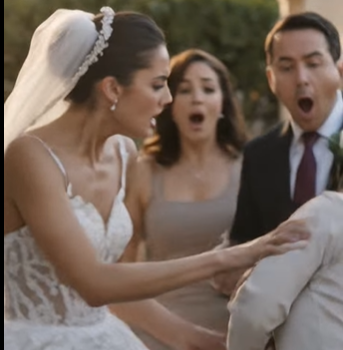
The sunlight still poured across the white aisle runner. The flowers still trembled softly in the breeze. But the entire ceremony had changed. What only moments earlier looked like a rich bride humiliating an unwanted guest had become something much more dangerous: a child standing in the open with his father’s face and no reason to stay quiet.
The bride no longer looked only furious.
She looked humiliated.
And then afraid.
Because once the child spoke, everything rearranged itself too fast to deny. The poor woman was no longer just a disruptive stranger among elegant guests. She was a mother standing at the edge of a truth the groom had clearly hoped would never arrive in daylight.
The boy clung to her side, confused by the silence around him but still staring at the groom with heartbreaking certainty. He was old enough to recognize a face. Old enough to ask questions. Old enough to destroy the timing of every lie built around him.
The poor woman unfolded the document with trembling fingers.
The older relative stepped closer first and took it before the wind could catch it.
He scanned the page.
Then stopped.
His whole expression changed.
“What is it?” the bride asked.
But her voice had lost its force.
The man looked up at the groom, then back at the paper.
“It’s a paternity acknowledgment,” he said. “Signed.”
A murmur tore through the guests.
The bride’s face went white.
The groom tried to step forward.
“It’s not that simple—”
The poor woman laughed through tears.
“Not that simple?” she said. “You signed it six months ago.”
That line shattered whatever dignity he had left.
Because now it wasn’t just suspicion.
Not resemblance.
Not gossip.
Not some desperate claim at a wedding.
It was paperwork.
His name.
His signature.
His son.
The bride stared at him as though every second of the last year had just turned against her. She remembered every delayed phone call, every unexplained trip, every strange silence when the future came up too directly. And now all of it had shape.
“You knew,” she said.
He didn’t answer fast enough.
That silence answered for him.
The poor woman said he told her he would announce the truth before the wedding. Then he said he just needed more time. Then he begged her not to come, saying public scandal would destroy everything. But the problem with men like him, she said, is that “everything” never includes the child waiting to be named in public.
The little boy looked up at the groom again.
“Are you my dad or not?”
No one breathed.
The groom looked like he might collapse under the weight of the question.
The bride turned to the child then, and that was the moment the whole wedding changed again. Because she no longer looked at him like an interruption. She looked at him like evidence.
The same eyes.
The same mouth.
The same expression when afraid.
The older relative lowered the paper slowly and said the one thing nobody wanted to hear but everyone already understood:
“He knew before he walked to this altar.”
The poor woman nodded.
“He knew before the invitations were sent.”
Now the wedding was no longer collapsing because of one secret.
It was collapsing because he had built the ceremony on top of a child he already acknowledged in private.
That was what made it monstrous.
Not that he lied.
That he planned around the lie.
The bride’s bouquet slipped from her hand and landed in the grass.
Nobody moved to pick it up.
She looked at the groom one last time and asked, very quietly:
“When were you going to tell me?”
He opened his mouth.
Nothing came out.
Too late.
The poor woman held her son close and said softly, “I didn’t come here to take your wedding. I came because he didn’t deserve to stand in front of God and pretend this child didn’t exist.”
That landed heavier than any scream.
The bride took one slow step back from the altar.
Then another.
The officiant said nothing.
The bridesmaids said nothing.
The guests only watched.
Because there was nothing left to protect.
The little boy tugged on his mother’s hand and whispered, “Can we go now?”
And somehow that was the saddest thing anyone had said all day.
The bride looked at the child.
Then at the groom.
And when she finally spoke, her voice was soft enough to make the entire wedding lean in.
“You didn’t ruin this ceremony,” she said to the poor woman.
Her eyes stayed on the groom.
“He did the day he signed his name and still chose this altar.”