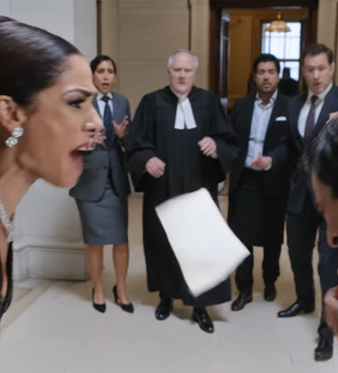
The courthouse hallway went dead silent.
The husband stared at the page in his hands, his fingers trembling so hard the paper crackled.
Slowly, he lifted his eyes toward his glamorous wife.
She had gone completely white.
“That is a lie,” she snapped. “A desperate lie.”
But her voice no longer sounded cold.
It sounded afraid.
The elderly judge stepped closer again, his face grim now. “This statement was never entered into the court record.”
The clerk wiped tears from her cheeks with shaking fingers.
“My mother was the records assistant the day they closed the case,” she said. “She saw the original witness statement before it disappeared.”
The husband looked at her sharply. “Disappeared?”
The clerk nodded. “She said someone with money made sure it never reached the hearing.”
The rich woman stepped backward. “This is insanity.”
But the husband was no longer listening.
He looked back down at the statement and read aloud:
I saw the second fiancée confront the bride on the upper stairwell before the hearing. I heard screaming. Then I saw the bride fall.
A murmur tore through the hallway.
Lawyers exchanged stunned looks. A bailiff moved closer. Even the guards near the staircase were openly watching now.
The rich woman shook her head wildly. “There was no second fiancée.”
The clerk let out a broken laugh through tears.
“My mother said that’s exactly what they wanted the court to believe.”
Then she reached into the inside pocket of her worn clerk’s jacket and pulled out a small yellowed envelope.
The judge’s eyes widened immediately.
“What is that?” the husband asked.
The clerk’s lips trembled. “The photograph they removed from the file.”
She handed it to him.
He opened it with shaking hands.
Inside was an old courthouse photo taken on the day of the inheritance hearing.
On the upper landing stood his first bride in white.
And beside her—
the same woman now standing next to him in emerald heels and diamonds, years younger, but unmistakable.
The husband nearly dropped the photograph.
“No…” he whispered.
The rich woman took another step back. “You don’t understand.”
But the judge took the photo from his hand, looked once, and closed his eyes.
“This should have been entered into evidence,” he said quietly.
The clerk’s tears kept falling.
“My mother kept the hidden file because she knew one day someone would try to erase me too.”
The husband looked at her, confused.
The clerk swallowed hard.
Then she said the sentence that shattered the hallway:
“She wasn’t declared dead before the hearing.”
The husband stared at her.
The judge stared at her.
The rich woman stopped moving.
The clerk’s voice cracked.
“She survived the fall long enough to give birth.”
The silence that followed felt inhuman.
The husband’s face drained of all color as he looked at the crying clerk again — really looked.
The eyes.
The shape of her mouth.
The same line in the chin.
The same face as the young bride in the photograph.
Then the clerk whispered the final blow:
“My mother didn’t keep the file to protect the case.”
She looked straight at him.
“She kept it to protect me.”