The husband stared at the paper in his shaking hands.
The gala had gone so silent that even the soft music from the string quartet seemed far away now.
Slowly, he read the next line aloud:
She chose her because she knew you would never look at me twice once the money was signed over.
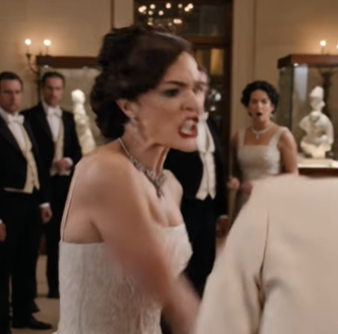
The rich woman stepped back. “This is madness.”
But the elderly curator was already staring at the assistant’s face with widening eyes.
The assistant wiped at her tears, but they would not stop.
“My mother said she begged to see you,” she whispered. “She said your mother told her you had agreed to the swap.”
The husband looked sick.
“No,” he said under his breath.
The assistant nodded through tears. “She believed it. She ran before dawn because she thought the wedding was a trap.”
The rich woman snapped, “This girl is inventing a story for attention.”
But the curator took the note and carefully unfolded the bottom corner.
“There is more,” he said.
Hidden beneath the first message was a second line, written smaller, hurried, uneven:
If my daughter survives, the portrait will prove whose blood they tried to erase.
A collective gasp moved through the room.
The husband looked up sharply.
The assistant’s breathing broke.
“She told me,” she whispered, “that if anyone ever opened the locket in front of you, I should not tell you my name first.”
The rich woman had gone completely pale now.
The husband stepped toward the assistant.
For the first time, he was no longer looking at the locket.
He was looking at her face.
Her eyes.
The line of her mouth.
The same eyes as the young bride in the miniature portrait.
The same quiet expression.
The same living shadow of the woman his family claimed had vanished forever.
Then the assistant reached into the pocket of her museum uniform and pulled out a second item:
a tiny antique key on a faded ribbon.
The curator gasped the moment he saw it.
“That key,” he whispered, “opened the bride’s private dowry chest.”
The husband took it with trembling fingers.
The ribbon tied to it was embroidered with one set of initials.
Not the rich woman’s.
Not his mother’s.
The vanished bride’s.
The assistant’s voice cracked as she delivered the final blow:
“My mother said the chest was never empty.”
The rich woman shook her head desperately. “Don’t listen to her.”
But the assistant was staring only at the husband now.
“She said your mother did not steal the locket because of the dowry.”
The room froze.
The husband’s hand tightened around the key.
Then the assistant whispered:
“She stole it because it contained the portrait of the real bride… and proof that I was her daughter.”