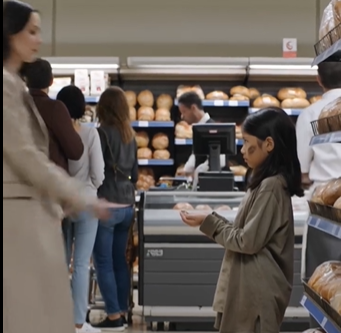
“That’s ridiculous,” she snapped. “She’s just saying anything for pity.”
But nobody was listening to her now.
Every eye in the aisle was on the bakery worker.
His hands were trembling so badly he had to set the tray down. He stared at the little girl as if the past had just walked back into the store.
Then he knelt in front of her.
“What did your mother tell you?” he asked, his voice cracking.
The girl was still crying as she opened her small fist. Inside was one last coin she had managed to protect.
“It’s not for bread,” she whispered. “She said if the man who bought two loaves sees me, I should give him this.”
The worker took the coin.
The second he turned it over, all the color left his face.
Taped to the back was a tiny folded piece of paper.
The aisle fell completely still.
With shaking fingers, he unfolded it.
It was old. Worn. Nearly torn through.
And written in faded ink were the words:
If she comes back alone, don’t let them see her before my father does.
A gasp moved through the shoppers.
The worker looked at the little girl, horrified.
“Your grandfather…” he whispered. “Your mother was trying to get you to your grandfather.”
The elegant woman took a sudden step backward.
The cashier noticed first. “Why are you leaving?”
Everyone turned.
The rich woman’s face had gone white.
The bakery worker rose slowly, staring at her in disbelief. “You were there that night,” he said.
She tried to laugh, but her voice failed.
The little girl looked between them, confused and shaking.
Then the worker pointed at the woman with a trembling hand.
“She wasn’t just in the parking lot,” he said. “She was the one your mother was running from.”
The entire supermarket exploded into shocked whispers.
The girl’s lips trembled.
And just before the woman could run, the child looked straight at her and whispered the first word she had said in years:
“Auntie.”