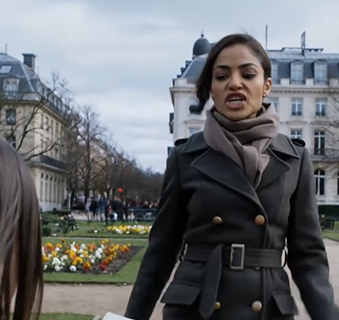
“That proves nothing,” she said, but her voice came out thin and unsteady.
No one was listening to her anymore.
The old violinist was staring at the child as if the air had been knocked out of his lungs. He dropped to his knees in front of her, not caring about the cold stone path beneath him.
“Who gave you that music?” he asked, his voice shaking.
The little girl was crying too hard to speak at first. Then, with freezing fingers, she picked up one torn page and held it out to him.
“My mother,” she whispered. “She said if I ever got hungry or scared, I had to find the man who wrote it… before the sun went down.”
The violinist took the page.
In the corner, almost hidden by a crease, was a tiny handwritten note he recognized instantly.
It was not the song that made him go pale.
It was the handwriting.
His daughter’s.
A gasp caught in his throat.
He turned the paper over with trembling hands and found four faded words written on the back:
Trust no woman in white.
The whole park seemed to stop breathing.
Slowly, the violinist lifted his eyes from the note.
The elegant woman standing over them was wearing a white coat.
Her face had gone completely still.
The child looked from the paper… to the woman… and suddenly began trembling even harder.
The violinist rose to his feet, clutching the torn music in one hand like evidence from a grave.
“You were here that day,” he said.
The woman stepped back.
“I don’t know what you think—”
But he cut her off.
“I remember your face.”
The people filming moved closer. The silence turned sharp.
The little girl stared at the woman, terrified, as if some buried memory had just opened inside her.
Then the violinist noticed something around the child’s neck — a tiny silver treble clef charm.
He had given that exact charm to his daughter when she was sixteen.
His eyes filled with tears.
The woman took another step back.
The little girl looked up at the violinist, lips trembling…
and whispered the words that made the entire park go still:
“Grandpa?”