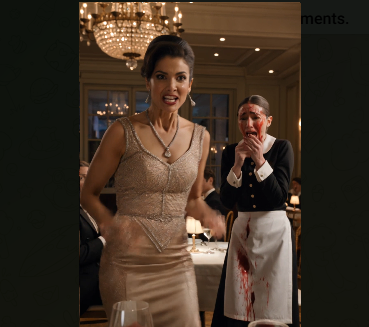
She was not rich.
She worked in the same restaurant as a pianist’s assistant, quiet and elegant, with a silver pendant she wore every day around her neck. He fell in love with her in secret, and for a while he promised her a future no one else knew about.
Then his family found out.
To them, she was a scandal waiting to happen.
Too poor.
Too unknown.
Too dangerous to the image they had built around him.
But the truth was worse than simple disapproval.
She became pregnant.
When she told him, he swore he would protect her. He rented the private upstairs suite and hid her there for a few nights while he tried to figure out how to take her away before his family could interfere.
Then the fire happened.
It broke out late at night, spread through the upper floor, and by morning everyone was told she had died inside.
The suite was sealed.
The story was buried.
And within a year, he was publicly engaged to the woman who had just thrown wine into the waitress’s face.
But the girl in the fire had not died.
She escaped through a service stairwell, badly injured, half-conscious, and carrying the pendant he had once given her. Inside it, he had hidden a brass key to the suite and a note in his own handwriting — a promise that if she ever had to flee, she should keep the key until it was safe to return.
She disappeared to protect the child.
That child was the waitress.
Her mother raised her in silence, fear, and poverty, never speaking the father’s name out loud. But before she died, she handed over the pendant and said only one thing:
Take it back to the man who locked me in that room and watch his face when he sees it.
Now, in the middle of the restaurant, the husband’s hands were shaking so badly he could barely stand.
Because the waitress did not just have the pendant.
She had her mother’s eyes.
The maître d’, pale as stone, whispered that he remembered the fire too clearly. The room had smelled of gasoline before the smoke spread. The doors to the suite had been locked from the outside.
That meant it had never been an accident.
The rich wife slowly turned toward her husband, horror spreading across her face, because she realized what the note truly meant:
If she escaped, then someone had tried to kill her.
Then the waitress reached into her apron and pulled out one more thing:
an old birth record, folded and worn at the edges.
The father’s name had been left blank.
But clipped to it was a photograph of the husband from years earlier, holding the same silver pendant in his hand, smiling at a woman whose face had been partly burned away by time.
On the back, in faded ink, her mother had written:
He loved us once. Ask him who set the fire.
The husband looked like he was about to collapse.
Then the waitress said the line that shattered the room:
“My mother didn’t send me here to prove who my father is.”
He stared at her in terror.
And she finished:
“She sent me here because the woman who locked the suite door is sitting at your table.”