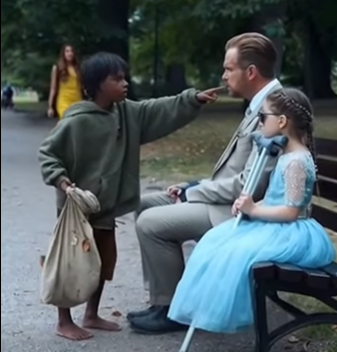
“She’s frightened,” she said. “She repeats things she doesn’t understand.”
But her voice came too fast.
Too ready.
The father did not even look at her.
He kept his eyes on the bottle.
The homeless boy was shaking now, not with cold, but with the terror of someone who had already said too much to survive being wrong.
“How do you know this?” the father asked.
The boy swallowed hard.
“I sleep near the service alley behind your house,” he said. “By the trash wall.”
The wife shut her eyes for half a second.
That was all the father needed to notice.
The boy continued, words stumbling over each other now.
“Sometimes the cook throws food out late. Sometimes the nanny takes her outside when she cries. I heard her say the drops make the girl weak enough to stay sick.”
The father turned toward his daughter again.
The little girl sat rigid, hands tight around the crutch.
He spoke gently now. Too gently.
“Can you see me?”
The child didn’t answer.
The wife stepped forward. “Stop this. He’s manipulating—”
“Can. You. See. Me.”
The girl’s breathing trembled.
Then, slowly, she nodded.
The father shut his eyes.
Not for long.
Just long enough to feel the world rearrange itself.
When he opened them, he was no longer looking at the boy like an intruder.
He was looking at him like a witness.
The child whispered, “She said if I tell you, you’ll send me away.”
The father’s head turned toward his wife.
“Who told her that?”
No answer.
The boy pointed at the bottle.
“She dropped that near the hedge yesterday,” he said. “I kept it because she came back looking for it with gloves on.”
The wife’s face tightened.
The father saw everything now — the gloves, the backward step, the bottle, the fear.
Then the little girl said the sentence that broke whatever was left of the lie:
“She said I have to stay blind until you sign.”
The father went still.
The boy frowned. “Sign what?”
The wife’s silence was louder than any answer.
The father looked at his daughter. “What did she mean?”
The little girl’s lips trembled.
“The new papers,” she whispered. “The ones about who gets everything if you die first.”
Now even the wind felt cold.
Because the poison was never just about the child.
It was about the man on the bench noticing too late that someone had been rehearsing his daughter for inheritance.