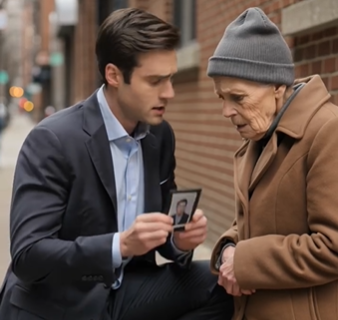
Not because he didn’t hear her.
Because he already knew there was something on the back.
A faded note.
A date.
Something his wife had once brushed off with a smile too quick to question.
He turned the photo over anyway.
The old woman’s eyes filled before he even finished.
On the back, in slanted handwriting, were four words:
Summer fair, age fourteen.
The man went still.
Because his wife had told him she never went to that town as a child.
Never lived near it.
Never knew anyone there.
Never even liked carnivals.
The old woman looked at the writing and made a broken sound in her throat.
“I wrote that,” she whispered.
Now his mouth went dry.
He looked from the ink to her face, searching for a crack, a performance, a trick.
But grief has details lies don’t carry.
“She wore blue ribbons that day,” the woman said softly. “She won a stuffed rabbit and then cried because it got dirty in the mud.” Her breathing shook harder. “She hated when I braided her hair too tight.”
The young man stopped blinking.
These weren’t broad guesses.
These were private textures.
The kind that don’t come from resemblance.
He stared at the picture again.
At his wife’s face.
Then at the old woman sitting in front of him on the sidewalk in a coat too heavy with years and weather.
“If this is true,” he said quietly, “why would she never tell me?”
The old woman closed her eyes for a second.
When she opened them, there was something worse than grief there.
Fear.
“She didn’t run from me,” she said. “She ran with someone.”
The air seemed to tighten around him.
“A man?” he asked.
The old woman shook her head.
“No. A woman.”
That hit harder.
Because now the story was no longer simple abandonment.
It was disappearance.
Maybe grooming.
Maybe theft.
Maybe a whole life rebuilt under another hand.
The man’s fingers tightened around the wallet.
“My wife told me her parents died when she was sixteen.”
The old woman looked at him with a kind of pity that made his stomach turn.
“I’m still alive,” she said.
Silence.
The city kept moving behind them like it had no right to continue.
Then the old woman asked, very softly:
“Does she still have the scar behind her left ear?”
His face changed before he could control it.
Because she did.
A tiny pale crescent his wife once told him came from “a childhood fall,” and which he had kissed without ever imagining it might be evidence.
The old woman saw the answer in his eyes.
And that was when she whispered the sentence that turned his unease into dread:
“Then the woman who took her gave her back the wrong story too.”