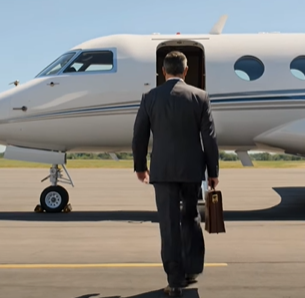
Not louder.
Worse.
Quieter.
Because now every person near the jet understood the same thing at once: a child had just described sabotage in the calm voice of someone who had watched it happen too closely.
The older man did not board.
He did not even take another step toward the stairs.
He set the briefcase down slowly and looked at the boy the way powerful men look when they realize the smallest person in the scene may be the only honest one.
“What exactly did you see?” he asked.
The boy swallowed hard.
“A man in orange headphones,” he said. “He was under the wing. Then he crawled out and looked around like he was scared.”
The flight attendant’s face tightened. “Ground crew uses orange headsets.”
The boy shook his head at once.
“No. These were broken. One side was hanging.”
That detail landed.
Because lies usually get broader under pressure.
Truth gets smaller.
The older man turned toward the plane again, eyes narrowing now.
“Where is he now?” he asked.
The boy looked over his shoulder toward the service vehicles parked farther down the runway.
“He got into a fuel truck,” he whispered.
Now even the attendant stopped pretending this might be a misunderstanding.
The sun still shone. The jet still gleamed. The stairs were still lowered. But the whole scene had flipped: what looked luxurious a minute ago now looked exposed.
The older man crouched slightly to the boy’s eye level.
“Why were you under there?”
The boy’s lips parted, then pressed together again.
That hesitation was bad.
Not because he was hiding a lie.
Because he was deciding whether telling the truth would get him sent away before anyone checked the plane.
Finally he said:
“I sleep near the fence.”
The man stared at him.
The boy looked down.
“I go there when the engines start,” he whispered. “It’s warm.”
That made the whole thing worse, not better.
Because now the warning wasn’t coming from some official observer or heroic witness.
It was coming from a child the airport had already trained itself not to see.
The older man rose slowly.
Then the boy said the line that made him stop cold:
“He saw me watching.”
The man turned back.
The child’s face had gone white.
“He bent down and said,” the boy whispered, “‘Good thing no one believes runway kids.’”
Silence.
Real silence.
Because now this wasn’t only about a bomb, or sabotage, or an attempted crash.
Now it was personal.
The saboteur had known he was being watched — and had still walked away confident the only witness was invisible enough not to matter.
The older man looked at the jet, then at the child, then toward the service road where the trucks were parked in bright daylight like ordinary machines.
And suddenly he understood the most dangerous part of all:
the bomb, if there was one, wasn’t the only plan.
The real plan was that the one person who saw it would be ignored.