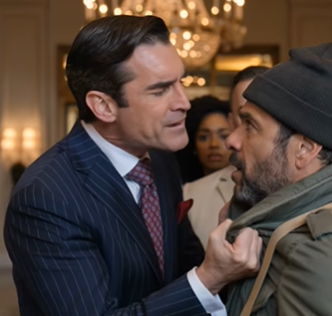
It stopped the room.
The suited man let go of the old man’s collar, but too late for dignity. The damage was already done. Everyone nearby had seen the crack in his face — not confusion, not outrage, but recognition arriving where arrogance had been standing a second earlier.
The officer’s hand loosened slightly from the old man’s back.
“Sir,” he said, more carefully now, “what is your name?”
The old man didn’t answer him.
He kept looking at the younger man.
The canvas bag hung from his shoulder, old and weathered, the kind of bag people stop seeing after the first assumption: homeless, harmless, disposable. But now the man in the beige coat was staring at it too, and so was the woman with curls, because suddenly the bag didn’t look random.
It looked deliberate.
The suited man found his voice first.
“You’re insane,” he snapped. “My family owns this property.”
The old man nodded once.
“That’s true,” he said.
A beat.
“Your family has owned it since the fire.”
The lobby changed again.
Now even the officer didn’t move.
The older man reached slowly into the canvas bag.
No one stopped him.
He pulled out a flat leather folder, cracked at the edges, tied with a fading hotel ribbon older than the younger man himself. He held it up, not dramatically, not like a threat — like proof he had carried too long.
The woman with curls whispered, “Oh my God.”
Because stamped in faded gold across the front were three words:
Vale Grand Archive
The same name still etched in tiny brass letters behind the reception desk.
The suited man’s face drained.
The old man opened the folder.
Inside was an original lobby photograph.
The same chandelier.
The same marble.
The same staircase.
And standing beneath it, arm in arm, was a young woman with the old man’s eyes.
Beside her, smiling at the camera, was the suited man’s father.
The officer took the photo before he could stop himself.
On the back was handwritten text:
Opening week. Mira Vale with investor Daniel Cross. Two days before the transfer.
Now the younger man stopped pretending.
“She ran away,” he said.
Wrong move.
Because innocent men deny theft.
Guilty men explain disappearance.
The old man looked at him with something harder than anger.
“My daughter didn’t run,” he said. “She vanished after refusing to sign.”
Silence.
Real silence.
Then the old man touched the red pocket square in the younger man’s hand with one shaking finger.
“She hated those,” he said softly. “Said your father wore red when he wanted people to think money made him charming.”
The suited man stepped back.
That was when everyone knew.
Not because the old man had proven every detail yet.
But because the rich man no longer looked offended.
He looked inherited.
And the officer, still holding the old photograph, asked the one question that made the younger man finally lose color:
“Why is the current ownership deed signed three months after her supposed disappearance?”
The old man didn’t smile.
He just looked around the hotel lobby one long time, then back at the man who had grabbed his collar and said:
“You were right about one thing.”
A beat.
“People like me don’t belong in your hotel.”
Another beat.
“People like me built it.”