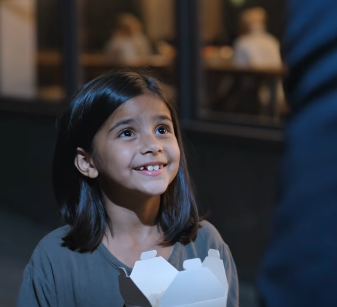
they look at food before they look away from it.
And she had looked at that rice like it was dangerous to want it.
The younger children didn’t notice.
They were too relieved.
Too fast with their hands.
Too used to joy arriving in portions small enough to disappear quickly.
But the man standing outside saw everything.
The way she kept swallowing while serving them.
The way her eyes stayed on the pan but never on her own empty hands.
The way the older woman — her mother, clearly — looked at her with a kind of broken gratitude that only exists when a child has become something she never should have had to become.
The mother spoke softly.
“You eat too.”
The girl shook her head immediately.
“I did,” she said. “Really.”
Another lie.
Smaller this time.
Worse.
One of the younger children looked up and asked, mouth already full, “Did the restaurant man give you extra?”
The girl smiled again — that same quick smile from outside, the one too practiced to belong to childhood.
“He gave enough.”
The man in the doorway shut his eyes for one second.
Because now he understood that this was not just poverty.
This was management.
Portioning.
Protecting.
Pretending.
A child learning how to make one meal become four people’s hope.
Then the smallest boy in the room looked at the older woman and asked the question that changed everything:
“Is Dad coming back if we eat slow?”
The little girl froze.
The mother looked down.
And the man outside felt the whole room go colder without any wind entering it.
No one answered right away.
That silence told him more than words would have.
The little girl finally knelt beside the youngest child and touched his hair gently.
“Eat,” she whispered.
Not yes.
Not no.
Just eat.
Now the man understood why she had run so hard with the box closed against her chest.
It wasn’t only about hunger.
It was about ritual.
About keeping alive the version of home where food still arrived from a father, even if only for a few more nights.
Then the older woman looked toward the doorway.
She saw him.
And instead of shame, instead of panic, her face changed into something more painful:
recognition.
Not of him.
Of what he had just witnessed.
The man stepped inside at last, barely breathing, and whispered:
“That’s a lie.”
The little girl turned, terrified for the first time since he had given her the box.
Not because he had followed.
Because she thought he might take back the dignity of the lie.
Then the mother said the one sentence that made his hands go cold:
“It’s the one story that still gets them to sleep.”