Not because of the noise itself.
Because of the way the old woman said it.
Not surprised.
Not confused.
Afraid.
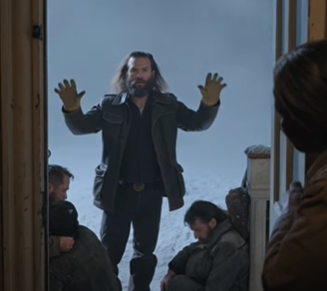
The bearded man looked toward the staircase, then back at her.
“Who’s upstairs?”
She didn’t answer.
That was answer enough.
One of the exhausted men on the sofa forced himself upright. Another near the stairs stopped pretending he was just checking the room. Now everyone understood the same thing at once:
this was no longer a story about strangers asking shelter in a storm.
This was a house already holding something secret enough to frighten the person inside it.
The old woman lifted her chin, trying to recover the authority she had at the door.
“You eat my heat, you keep your questions,” she said.
But her voice shook on the second half.
The bearded man noticed.
He noticed everything.
The thermostat under his hand was turned almost all the way down. The room wasn’t poor-cold. It was rationed-cold. Controlled. Like somebody was trying to make the house survive on less than survival required.
Then the sound came again.
Smaller this time.
A dragging step.
Followed by a cough.
The man nearest the staircase went pale before anyone else did.
Because now it didn’t sound like a loose pipe or old wood.
It sounded like a person trying not to be heard.
The bearded man took one step toward the stairs.
The old woman moved fast for the first time and blocked him.
“No.”
That one word told him everything.
Not because it explained.
Because it protected.
“Ma’am,” he said carefully, “if there’s someone up there who needs help—”
“She doesn’t need help,” the woman snapped.
Wrong sentence.
Because people protecting the safe say they’re fine.
People protecting a secret say don’t look.
The wind howled outside hard enough to rattle the door.
Inside, the room held its breath.
Then the old woman’s eyes filled before she could stop them.
And in a voice barely above the storm, she said:
“She only comes down when men aren’t in the house.”
Silence.
Real silence.
The bearded man didn’t move.
Now this was something else entirely.
Not just poverty.
Not just fear.
History.
He looked at the staircase.
Then at the old woman.
Then at the cracked plaster wall beside the lamp, where a child’s height marks had been scratched into the paint for years and then suddenly stopped.
“How old?” he asked softly.
The old woman shut her eyes.
“Fourteen.”
One of the men near the stairs swore under his breath.
The bearded man’s face hardened, not with anger exactly, but with recognition — the kind that comes from seeing too many houses where survival and captivity have learned to wear the same coat.
Then, from the darkness upstairs, a girl’s voice finally broke through:
“Grandma… did they find us again?”