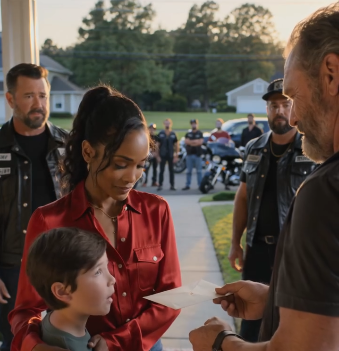
Not the boy.
Not the woman.
Not the bikers spread across the driveway in the last light of day.
Because now the envelope was no longer just an envelope.
It was a delayed answer.
The woman stared at the older biker like she had waited years to hate this moment and still wasn’t ready for it to arrive.
“Don’t,” she said softly.
But her voice didn’t sound angry.
It sounded tired.
The biker nodded once, as if he had expected that.
“He didn’t leave because he stopped loving you,” he said.
The woman shut her eyes.
That sentence was too old, too cruel, too familiar. People always say love when they arrive late with damage in their hands.
The boy looked between them, confused now.
“Who are you talking about?”
The woman’s hand slipped from his shoulder to his hair, protective even now, even with her own breath unsteady.
The biker held out the envelope a little farther, but still did not step onto the porch.
“Your father,” he said.
The boy froze.
The woman’s face broke, not dramatically, just enough to show that this was not a dead stranger’s name. It was the one wound she had built her whole life around never reopening in front of her child.
The older biker continued, quieter now.
“He rode with us for six years. Saved two of my men. Buried three more. And when he knew he wasn’t coming back from the last run, he gave me that envelope and told me something I’ve hated living with ever since.”
The boy stared at the white paper like it might suddenly explain why his mother looked more afraid of hope than grief.
“What did he say?” the child asked.
The biker looked at him directly.
“He said your mother would survive losing him,” he answered. “But she would never forgive being found too soon.”
Silence.
The woman covered her mouth.
Because that sounded like him. Too much like him.
The biker finally placed the envelope on the porch step instead of handing it directly to her.
Inside it, visible now through the slight opening in the flap, was not just a letter.
There was a photograph.
Old. Folded. Kept.
The boy saw it first.
A man in riding leathers, smiling, younger than memory, holding a newborn wrapped in a blue blanket.
Holding him.
The child’s voice came out tiny.
“That’s me.”
The woman made a sound that wasn’t quite crying yet.
The biker nodded.
“He wanted your son to see his face before he saw the truth.”
Now even the men in the yard looked away respectfully.
Because this was not a biker gathering anymore.
This was a father finally arriving too late to knock.
The woman bent slowly, picked up the envelope, and held it like something that could still explode.
Then the boy asked the question no one on that lawn had been brave enough to ask for years:
“If he loved us…”
His voice trembled.
“…why didn’t he come home?”
The biker’s face tightened with the kind of regret men carry when they obey the wrong promise for too long.
And he answered:
“Because the people hunting him found your name before he could burn it.”