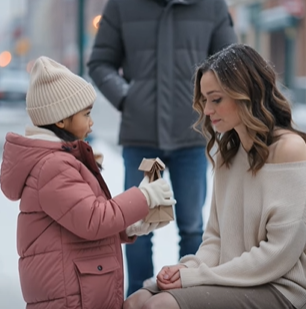
The woman on the bench held the paper bag in both hands, but she was no longer looking at it.
She was looking at the little girl.
Really looking at her.
At the shape of her eyes.
The softness of her cheeks.
The tiny crease near her eyebrow when she tried not to cry.
And then the child said, in the smallest voice:
“Daddy says Mom loved winter too… before she disappeared.”
The woman stopped breathing.
Her fingers tightened around the bag so hard it crumpled.
The man in the background stepped closer now, his face suddenly drained of color.
The little girl kept talking, innocent and hopeful, unaware that every word was tearing open something buried.
“He says she used to sing when it snowed,” she whispered. “And that when I was a baby, she kissed my hands to keep them warm.”
The woman’s eyes overflowed.
Without realizing it, she reached forward and touched one of the child’s white gloves.
Her hand trembled violently.
Because she remembered.
Not clearly.
Not all at once.
But enough.
A nursery.
A lullaby.
A tiny pink blanket.
A man’s voice shouting.
A door closing.
Snow.
The little girl tilted her head.
“Why are you crying?”
The woman tried to answer, but no sound came out.
The man was close enough now to hear every breath.
His expression had changed from concern to something much darker.
Fear.
The child turned and saw him.
“Daddy,” she said softly, “she looks at me like she knows me.”
The woman shut her eyes.
One tear slipped down her cheek.
Then another.
When she finally looked at the man, her voice was barely a whisper.
“How old is she?”
He answered immediately.
“Six.”
The woman gave a broken nod, like that number had cut straight through her.
Then she asked the question that made his heart stop:
“Was she born in January?”
The man went completely still.
Snow landed on his shoulders and melted there, but he didn’t move.
“Yes,” he said.
The woman’s hand flew to her mouth.
The little girl looked back and forth between them, confused now.
“Daddy?”
His voice came out rough.
“Why are you asking that?”
The woman looked at the child again.
This time not with pity.
Not with kindness.
But with the unbearable ache of someone looking at a love they thought was lost forever.
Then she whispered:
“Because I had a daughter… and they told me she died.”
The world seemed to go silent.
No traffic.
No wind.
No piano.
Nothing.
The little girl frowned.
“Who died?”
The woman burst into tears.
The man stared at her like he no longer recognized the world standing in front of him.
“No,” he said weakly. “That’s impossible.”
She shook her head, crying harder now.
“Six years ago, I woke up in a hospital after the accident. They told me my baby was gone. They said there was nothing left to bury. I begged to see her, but they wouldn’t let me. Then your mother came to me—”
She stopped.
The man’s face changed instantly.
“My mother?”
The woman nodded.
“She told me I was unstable… that I would only ruin the child if she had survived. I thought she was cruel. I didn’t know she was lying.”
The little girl clutched her father’s coat.
She was frightened now, but she could not look away from the woman.
The woman slowly reached into the paper bag, but instead of food, her shaking fingers found something at the bottom.
A tiny silver charm.
A half-heart.
She stared at it and broke.
From around her neck, hidden beneath the torn sweater, she pulled out the other half.
The same silver.
The same tiny engraving.
Together, they formed one heart.
The man’s knees nearly gave out.
The little girl looked down at the matching pieces, then up at the woman, and whispered:
“Why do you have mine?”
The woman sobbed so hard she could barely speak.
Because when the baby was born, she had split the charm in two.
One half for her.
One half for her daughter.
A promise that no matter what happened, they would always find each other.
The man knelt beside his child, his hands shaking now too.
He looked at the woman on the bench—not as a stranger, not as someone broken by the street—
but as the person he had spent six years mourning beside a child who never stopped asking where her mother had gone.
His voice cracked.
“Emma…”
The woman looked at him and began crying even harder.
She had not heard her name spoken with love in years.
The little girl stared at both of them, trying to understand.
Then, very softly, she asked:
“Are you my mom?”
No one on that street was ready for how small her voice sounded when she said it.
The woman covered her face and nodded.
The child did not run.
Did not smile.
Did not even speak at first.
She just stood there in the falling snow, trying to understand how a person could be gone for so long and still cry like they had been missing you every day.
Then she took one tiny step forward.
And another.
And another.
Until she was close enough to touch her.
The woman looked terrified to reach back, like she thought she had no right.
But the child solved that for her.
She climbed into her lap.
Cold boots.
Soft coat.
Tiny arms around a shaking neck.
And the woman let out the kind of cry that comes from years of surviving without hope.
She held the little girl like someone holding her whole life after believing it was buried.
The father turned away for a second because he could not hide his tears.
Snow kept falling onto all three of them.
The child pressed her cheek against the woman’s and whispered:
“I knew you were cold.”
That sentence shattered them both.
Because she had offered food…
when what she had really found was her mother.
The woman kissed her forehead again and again through tears.
“I’m sorry,” she kept whispering. “I’m so sorry. I never left you. I never wanted to leave you.”
The little girl pulled back just enough to look at her.
Then she asked the question only a child could ask:
“So… can you come home now?”
The woman closed her eyes.
The father stepped forward, knelt beside them both, and gently wrapped his arms around them.
His answer was quiet, broken, and full of everything they had lost:
“Yes. This time, we all go home together.”
And there, on a freezing bench in the middle of a snowy street,
a little girl who only wanted to feed a stranger
ended up bringing her family back to life.