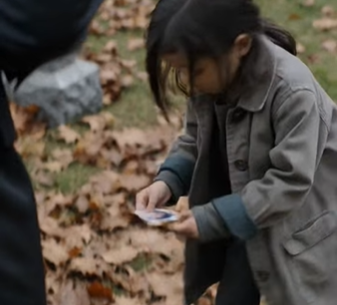
The cemetery, the wind, the leaves, the gravestone — all of it disappeared behind the sound of that one sentence.
He slowly pulled back and stared at the girl.
“Who raised you?” he asked.
The child looked down at the photo, rubbing the corner of it with her thumb.
“A woman from the church took me first,” she said softly. “Then another lady came and said she was sent by my mommy’s family.”
His heart started pounding harder.
“What lady?”
The girl hesitated.
“She wore black gloves,” she whispered. “And smelled like roses.”
The man went pale.
Because he knew exactly one person who always wore black gloves and rose perfume.
His mother.
He stood up too quickly, almost stumbling, then looked back down at the little girl as if afraid she would vanish if he blinked.
“What is your name?” he asked.
The child answered quietly.
“Clara.”
That name hit him like a knife.
Years ago, when he and the woman in the photograph talked about the future, they had picked only one baby name together.
Clara.
No one else knew that.
No one except the two of them.
His mother had not only lied.
She had known.
Known the baby survived.
Known where she was.
And hidden her for five years.
He took the little girl’s freezing hands into his.
“Did the woman who raised you ever tell you why your mother died?”
Clara shook her head. “Only that she cried a lot before I was born. And that she kept saying, ‘He doesn’t know. He doesn’t know what they did.’”
The man looked back at the gravestone, his eyes filling again.
He remembered that night now in flashes he had tried for years to bury: his mother insisting he stay away from the hospital, his brother taking his phone, his father saying everything had “already been handled.”
Handled.
Not mourned.
Not survived.
Handled.
Then Clara reached into her ripped coat pocket and pulled out something small.
A silver hospital bracelet.
Faded. Bent. Old.
He took it with trembling fingers.
On it, beneath the mother’s surname, were two words written in blue ink:
Baby Girl — Held
His face changed.
Because he had never held her.
Which meant someone else had.
Someone who had seen the child alive after the birth.
Someone inside the family.
He stared at the bracelet, then at the gravestone, then back at his daughter.
And in that instant, grief turned into certainty.
His family had not protected him from tragedy.
They had created it.
He picked Clara up into his arms and held her tightly.
“You’re coming with me,” he said.
She wrapped her tiny arms around his neck.
But before he could carry her away, a black car rolled slowly to a stop just beyond the cemetery gates.
Clara saw it first.
And instantly began to tremble.
“That’s her car,” she whispered.
The man turned toward it.
The rear door opened.
And stepping out in black gloves, rose perfume drifting on the wind, was the one person he had buried in his heart years before:
his mother.