The cashier looked from the managers… to the old man… then back again.
“His clothes?” she repeated weakly.
The older manager looked horrified that he had spoken too fast.
But it was too late.
The old man slowly turned toward him.
“Yes,” he said. “Go on. Tell them whose clothes these are.”
The younger manager swallowed hard.
The whole checkout area was frozen now. Even customers in other lines had stopped pretending not to listen.
Finally, the older manager answered in a strained voice:
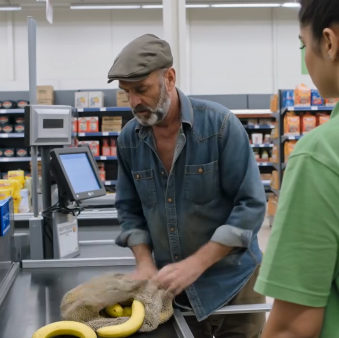
“They belonged to Mr. Hale’s brother.”
The old man’s expression didn’t change.
But the cashier noticed his grip tighten around the phone.
“He died six months ago,” the manager continued quietly. “On the street. Three blocks from our downtown branch.”
A chill ran through everyone nearby.
The cashier stared at the old man in horror.
Because suddenly the torn shirt, the scuffed shoes, the faded cap — none of it looked random anymore.
The old man looked down at his own clothes for a moment before speaking.
“My younger brother owned half this company with me,” he said. “After our father died, he disappeared from the board, from the family, from everything.”
He lifted his eyes again.
“I was told he had relapsed. Told he chose that life. Told he wanted no help.”
The managers looked sick.
The old man’s voice dropped lower.
“So I spent the last six months going store to store dressed like the kind of man people ignore… because I needed to know one thing before I opened his final letter.”
The cashier was crying now, though she didn’t even fully know why.
“What letter?” she whispered.
The old man reached into his inner pocket and took out a folded envelope, old and worn at the corners.
“He left instructions,” he said. “He wrote that if I wanted to know who stole his shares, forged his signature, and let him die in the street…”
His eyes moved slowly across the checkout lane.
“…I should start with the stores where staff had already been trained to treat poor people like trash.”
Nobody breathed.
Then he turned the envelope over and revealed one more thing:
the signature authorizing the fraudulent transfer of his brother’s ownership.
The cashier looked confused.
The male employee looked terrified.
Because the signature wasn’t from some stranger.
It wasn’t from a rival.
It wasn’t even from one of the managers.
It was from the woman standing behind the register.
The cashier stumbled backward. “No… no, I only signed what they told me—”
The managers went pale.
The old man stared at her, stunned.
Because he hadn’t expected the guilty person to be standing in front of him.
But then the cashier broke completely and cried out:
“I thought it was just paperwork! They told me he was already dead!”
And suddenly every eye in the store turned toward the two managers.