He looked sick.
For a moment he just stood there, staring at the photograph like it might change into something less dangerous if he blinked enough times.
But it didn’t.
The old man in the picture was unmistakable.
Younger, yes. Stronger. Cleaner. But the same face.
The same eyes.
The chef snatched the photo from the table with trembling fingers and turned it over.
On the back, written in old black marker, was a date from thirty-two years earlier — the same year the restaurant owner always described as “the year I built everything from nothing.”
Nothing.
That word suddenly felt different.
Because now there was proof he hadn’t built it alone.
The chef backed away and disappeared into the kitchen.
The restaurant had gone unnaturally quiet.
Even the diners who pretended not to care were listening now. Forks paused midair. Wine glasses hovered above tablecloths. One woman actually stood from her seat to get a better look.
The old man didn’t touch the food.
He didn’t wipe the spit away.
He just sat there with the patience of someone who had already waited too many years to be seen.
Less than a minute later, the kitchen doors burst open.
The owner came out so fast he nearly stumbled.
An elegant man in a dark tailored suit, silver at the temples, respected by everyone in the city. The kind of man who had spent decades turning his name into a symbol of taste, refinement, and power.
He crossed half the dining room before his eyes landed on the old man.
Then he stopped.
Completely.
Like his body no longer belonged to him.
The old man slowly stood.
The owner’s mouth parted, but no sound came out at first.
Finally, in a voice barely above a whisper, he said:
“André?”
The room went dead silent.
The old man nodded once.
The owner’s eyes filled instantly.
Because André was not supposed to be alive.
That was the story told for thirty years.
That he had died in a grease fire at their first restaurant.
That his body was never properly recovered.
That the owner had carried the guilt forever.
But André had not died.
He had burned.
He had suffered.
He had vanished.
And while he fought to survive in public hospitals under another name, his business partner — his “brother for life” — had taken their recipes, their investors, their dream, and built an empire alone.
The owner took one shaky step forward. “I thought you were dead.”
André gave a hollow smile.
“No,” he said. “You hoped I was.”
A murmur tore through the dining room.
The owner looked like he had been struck.
Then his eyes dropped to the plate.
To the spit.
To the chef standing pale and trembling near the kitchen doors.
And whatever remained of his composure disappeared.
“Who did that?” he asked, though he already knew.
Nobody answered.
André reached for the plate, lifted it slightly, then set it back down with perfect care.
“This dish,” he said quietly, “was mine.”
The owner shut his eyes.
Because he recognized it.
Of course he did.
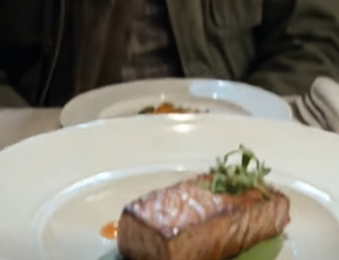
The green puree. The orange drops. The exact sear. The tiny herb placement.
It was the first signature plate André had ever created.
The plate that launched their first reviews.
The plate that opened investors’ wallets.
The plate the owner had claimed as his own for three decades.
André looked around the room at the wealthy guests, the chandeliers, the polished glasses, the empire built on stolen memory.
Then he said the sentence that shattered the owner in front of everyone:
“You didn’t just steal my recipe.”
His voice hardened.
“You stole my death.”
The owner started to speak, but André cut him off.
“I came tonight to see whether you still remembered me,” he said.
His eyes shifted toward the chef.
“Now I know what kind of man trains others to spit where he once betrayed.”
The owner turned ghost-white.
Because only one person besides him knew the full truth about the fire.
Only one.
The chef.
His own son.