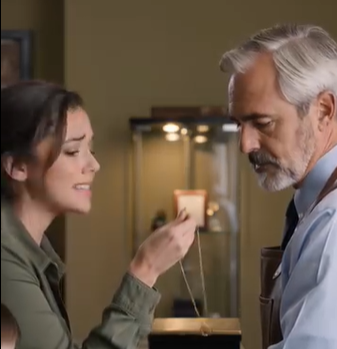
Not on purpose.
Her fingers simply stopped obeying her.
It fell against the glass counter with a tiny metallic sound that seemed far too small for the sentence that had just shattered her world.
“I buried your mother twenty years ago.”
Her son pressed closer to her side.
She stared at the photograph, then at the old man, then back at the pendant as if one of them had to be lying.
“No,” she whispered. “That’s impossible.”
The old man’s eyes filled, but he did not look confused.
Only tired.
Like someone who had carried the same lie for too long and no longer had the strength to hold it upright.
“She was supposed to disappear,” he said quietly. “That was the plan they forced on us. But she refused to leave without you.”
The woman’s heartbeat turned jagged.
“My mother raised me,” she said. “She died last winter.”
The old man shut his eyes for a moment.
“Then the woman who raised you was not the woman who gave birth to you.”
The pawn shop suddenly felt too small for air.
He pushed the old metal box closer. Under the photograph lay hospital papers, old receipts, and one folded note worn soft at the corners.
On the outside, in faded ink, was written only:
For my daughter, if she survives them.
The woman’s hands shook as she opened it.
Inside was a short note in the same handwriting as the labels her mother used to leave on jars, sweaters, schoolbooks.
But the words were nothing she had ever heard before.
It said she had been born during a winter storm in a private clinic outside the city. It said powerful people wanted her gone before sunrise. It said the pendant would be the only proof of who she was if anyone kind enough remained alive to tell the truth.
And at the bottom, one name:
Elena Varela
Not the name of the woman who raised her.
Not any name she knew.
The old man touched the silver ring beside the letter.
“She was my sister,” he said. “She fell in love with a married man from one of the richest families in the province. When she became pregnant, they paid people to erase the scandal.”
The woman’s eyes widened.
“Erase?”
He nodded once.
“They set fire to the clinic records. Paid a nurse to report both mother and child dead. Told the father the baby never survived. Told my sister she had to run or they’d finish what they started.”
Her son looked up at her, frightened now by the tears in her face.
The old man’s voice grew rough.
“She brought you to me for one night. Just one. She said she was going to meet the child’s father and force him to hear the truth.”
He looked down at the photo again.
“She never came back.”
The woman could barely speak. “Then who buried her?”
The old man’s jaw tightened.
“A body was found wearing her coat and pendant chain, burned too badly for a real identification. They wanted the case closed. I was young, terrified, and stupid enough to believe what they needed me to believe.”
He slid one final paper across the counter.
A newspaper clipping.
Yellowed. Cracked with age.
A smiling wealthy couple at a charity gala.
And beside them, in the background, half out of frame, was the same older man from the note’s story — younger then, elegant, powerful, hand resting on the shoulder of a small boy.
Under the photo, the caption named him.
The woman read it once.
Then again.
Because the name wasn’t unfamiliar.
It was the same surname her son carried on his school papers.
The same surname as the man who had abandoned them both two years ago.
Her voice turned to ice.
“You’re saying my son’s father…”
The old man looked at her with horror and pity mixed together.
“I’m saying,” he replied, “that you didn’t fall in love with a stranger.”
He paused.
“You fell in love with your half-brother.”