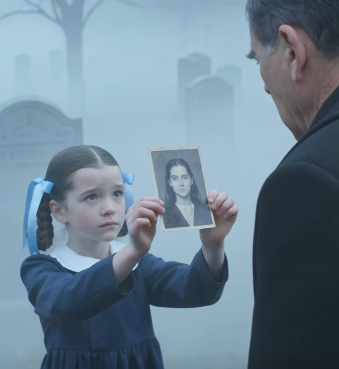
The fog, the graves, the chapel, the letter in his hand — all of it seemed to slide farther away as he stared at the little girl standing in front of him.
“What are you saying?” he whispered.
The child looked impossibly small against the ruined chapel door, pale ribbons stirring in the wind.
“My mother said I must never tell you too quickly,” she said. “Because if I did, you might hate me before you understood.”
Elias gripped the letter harder.
Hate her?
The very idea felt monstrous.
But something in Clara’s handwriting, in the silver ring, in the child’s face, had already begun building a truth he was afraid to name.
He looked down at the letter again and read faster.
Clara wrote that on the night of the crash, she had been trying to leave the city with evidence — bank files, recordings, and proof that Elias’s older brother had orchestrated the theft that ruined half the Mercer estate. But she had not been alone in the car.
There was a child with her.
A child no one knew existed.
A child Clara had hidden for six years.
Elias’s hands started shaking.
He looked slowly back up at the girl.
“No…”
The girl’s eyes filled, but her voice remained steady.
“She said you weren’t told because your brother watched everything. Every phone. Every driver. Every account. She said if he found out I was yours too, he would kill both of us.”
The world tilted.
Because now he saw it.
Not just Clara in the child’s face.
Himself.
In the eyes.
In the shape of the mouth.
In the quiet way she held grief too still for someone so young.
“You’re my daughter,” he said, but it came out broken, almost voiceless.
The child nodded once.
Then she pointed behind him, toward the fog beyond the chapel.
“She’s waiting.”
Elias turned so fast he nearly slipped on the wet stone.
At first he saw nothing except drifting gray.
Then a shape.
A woman standing beneath the dead yew tree at the edge of the cemetery path.
Thin. Pale. Wrapped in a dark coat. One hand against the trunk for strength.
Clara.
Alive.
For a moment, he could not move.
She looked older, fragile, marked by years no one had allowed him to witness — but it was her. Not a ghost. Not a dream pulled out of mourning. Her.
He took one step.
Then another.
But before he could reach her, Clara called out sharply, “Stop.”
He froze.
Not because of her voice.
Because of the fear in it.
She looked past him toward the cemetery gates, where dim headlights had begun glowing through the fog.
“They followed you,” she whispered.
The little girl grabbed his sleeve.
Elias turned.
A black car was rolling slowly between the tombstones.
Too deliberate. Too silent.
Clara’s face went white.
“Listen to me,” she said. “The grave was never meant for me.”
Elias stared at her.
Then at the approaching lights.
Then back at the woman he had mourned for seven years.
“What does that mean?”
Clara’s voice cracked for the first time.
“It means the body in my coffin…”
She looked at their daughter.
“…was my sister.”