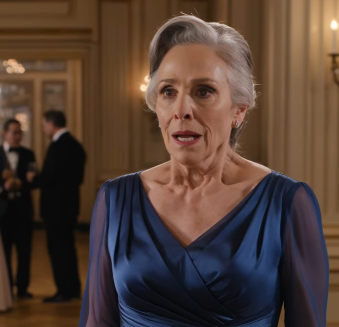
The orchestra had stopped.
The guests had stopped pretending not to stare.
Even the waitstaff stood frozen, trays in hand, as if the room itself understood that something old and buried had just stepped into the light wearing a borrowed uniform.
The waitress looked from the older woman to the silver-haired man, her pulse hammering so hard she could hear it.
“What did you say?” she whispered.
The older woman yanked her arm free from the man’s grip and turned on him with a face full of horror.
“You told me she died,” she said.
His jaw tightened.
“I told you what needed to be said.”
That answer shattered whatever remained of the room’s civility.
The waitress took a step back.
She had grown up with almost nothing — a shared room in a church home, hand-me-down shoes, a foster mother who loved her but feared questions, and one single necklace she had been warned never to sell, never to show, never to remove. She had never once imagined it belonged to a life like this.
Or a family like this.
The older woman reached for her hand again.
“My baby was taken the night the east wing caught fire,” she said through tears. “The nursery burned. The staff were locked out. And my husband told me by dawn there had been nothing left to bury.”
The waitress looked slowly at the silver-haired man.
Husband.
Which meant—
Her whole body went cold.
“You’re my father?” she asked.
The man’s face darkened. “No.”
But he said it too quickly.
The older woman shook her head, crying harder now. “He raised you in secret first. I know it now. I see it all now.”
The room went dead silent again.
Because this was no longer just the return of a lost daughter.
It was the collapse of a lie built over decades.
The older woman spoke with the trembling clarity of someone finally seeing her own life correctly.
“The night of the fire, he had already learned the truth,” she whispered. “That you were not his child.”
The waitress stared.
The silver-haired man closed his eyes for half a second.
Too late.
The guests understood before she did.
This was not a father terrified of losing a daughter.
This was a man terrified of a secret child returning.
The older woman’s voice broke. “I had loved someone else before my marriage. Just once. Just one mistake, one weakness, one truth he could never forgive.”
The waitress felt the floor tilt beneath her.
“So you hid me?”
The man finally spoke, cold and controlled again.
“I removed a scandal.”
A gasp ripped through the room.
The older woman lunged toward him as if she might strike him.
“You stole my child!”
But the waitress barely heard them now.
Because memories were moving for the first time.
The smell of smoke.
Church bells.
A woman running.
Hands passing her through darkness.
A lullaby no one at the orphanage could explain.
Then she remembered one more thing.
A priest.
Not old.
Young.
Holding her while whispering, You must never tell them your real name.
Her voice came out thin and shaken.
“The priest at Saint Agnes…” she said. “He used to visit my foster mother every winter.”
The older woman froze.
The man went pale.
That was the moment the waitress understood there was still one piece left.
One person who knew everything.
And then, from the top of the ballroom staircase, a calm male voice said:
“She’s right.”
Every head turned.
At the top step stood an elderly priest in black, one hand resting on the rail, the other holding an old leather file.
His eyes went first to the waitress.
Then to the silver-haired man.
And finally to the older woman.
“I baptized her myself,” he said quietly. “And I know exactly whose daughter she is.”